- Jun 08, 2026
Historic ‘July National Charter 2025’ Signed: Tensions, Dissent, and the Beginning of a New Political Era
- Oct 17, 2025
- Politics
PNN News Desk | Dhaka:
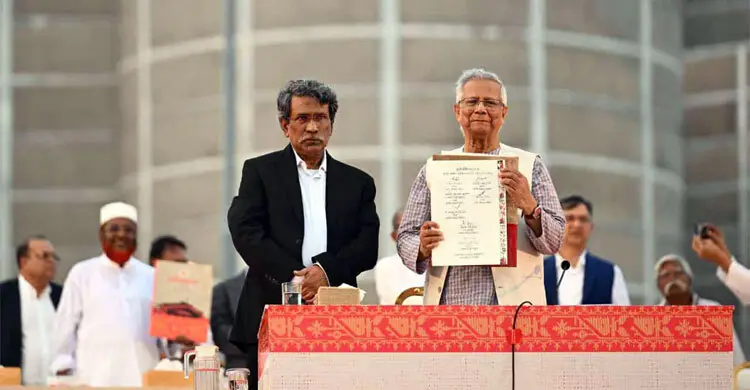
After eight months of dialogue, disagreements, and revisions, the much-discussed ‘July National Charter 2025’ has finally been signed. On Friday, October 17, at 5:05 PM, the document was signed by Professor Dr. Muhammad Yunus, Chief Advisor of the Interim Government and Chair of the National Consensus Commission, at a ceremony held in the South Plaza of the National Parliament Building. The event was attended by top leaders of various political parties, commission members, advisory council members, foreign diplomats, and other guests.
According to the Chief Advisor’s Press Wing, leaders of 25 political parties participated in this historic event. Among them were representatives from BNP, Jamaat-e-Islami, Ganadhikar Parishad, Nagarik Oikko, Amar Bangladesh (AB) Party, Ganasonghoti Andolon, JSD, Islami Andolon Bangladesh, Ganoforum, LDP, Khelafat Majlis, Rashtra Songskar Andolon, NDM, Biprobhi Workers Party, Nezam-e-Islam Party, Islami Oikkyo Jote, Labor Party, Jamiyate Ulema-e-Islam, Bhasani Jonoshokti Party, Jaker Party, Jatiyo Ganfront, Jatiyatabadi Samomona Jote, Amjontar Dal, among several others.
Representing the July martyrs’ families, the ceremony saw the presence of Mir Mostafizur Rahman, father of martyr Mir Mahfuzur Rahman Mughdur, and Shamsi Ara Begum, mother of martyr Tahir Zaman Priyo.
However, the National Citizens Party (NCP) and four leftist parties—Bangladesh Communist Party (CPB), Bangladesh Socialist Party (BASAD), BASAD (Marxist), and Bangladesh JASAD—did not participate. NCP media cell editor Mushfiq Us Salehin stated, “Without legal assurances, we will not sign the July Charter at this time.” Party convener Nahid Islam said in a meeting in Iskat, “Some political parties are deceiving the public under the name of consensus.” Similarly, the four leftist parties announced in a press conference on October 16 at Purana Paltan that they would not sign until they receive the revised draft.
Earlier on the morning of the ceremony, a group identifying as ‘July Warriors’ staged a protest near the Parliament, raising concerns over the charter’s legal basis and alleged devaluation of their sacrifices, which escalated into a clash with police involving stone-pelting and arson, injuring several activists and police personnel.
Once the situation was under control, the Consensus Commission convened an emergency meeting and amended Clause 5 of the Charter. The revised clause now ensures state recognition of the martyrs of the July uprising, financial assistance for the injured, and legal immunity for martyr families and injured activists.
In his opening remarks, Professor Ali Riaz, Vice-Chair of the National Consensus Commission, said, “We have many streams, but one estuary—the building of a democratic Bangladesh. This charter is the first step on that journey.”
The charter was prepared through two phases of dialogue with 63 political parties from February to July, outlining principles for constitutional reform, electoral system, administration, anti-corruption measures, police and judiciary reforms.
Although the Awami League was excluded due to suspension of activities and the National Party was considered an ally of fascism, the participation of 25 parties makes the charter a new historic document of political consensus.
Political analysts suggest that despite dissent and tensions, the July National Charter 2025 will go down in history as a landmark step toward democratic transformation and state reform in Bangladesh.

প্লিজ লগইন পোস্টে মন্তব্য করুন!
আপনিও পছন্দ করতে পারেন
- Jun 08, 2026
Strong Debate in Parliament Over Media Accoun...

- Jun 08, 2026
NCP Launches Week-Long Tree Plantation Drive,...
- Jun 08, 2026
Political Debate Erupts Over Viral Letter Sha...
- Jun 04, 2026