- Jul 03, 2026
Gonoadhikar Parishad Rejects July Declaration: "Unacceptable Without Recognition of Revolutionary Contributors"
- Aug 03, 2025
- Politics
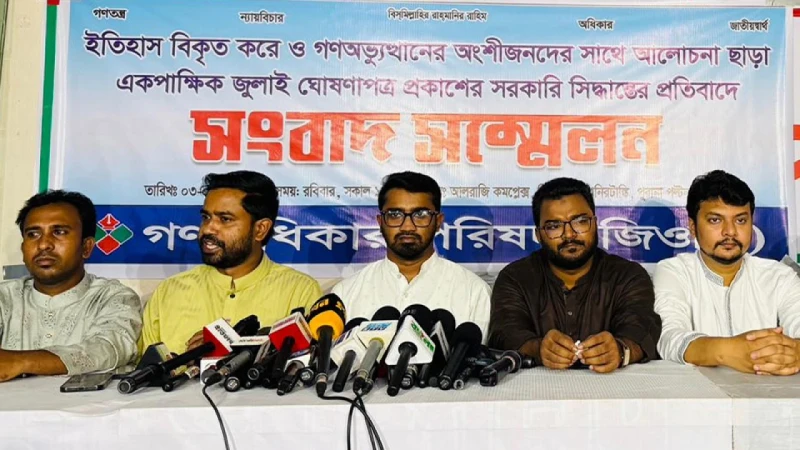
The Gonoadhikar Parishad has added a new dimension to the ongoing political debate surrounding the “July Declaration” following the historic mass uprising in July. In a press conference held on Sunday morning at the party’s central office in Al Razi Complex, Purana Paltan, the organization declared it would reject the declaration unless it includes consultation with and recognition of the actual participants of the revolution.
Gonoadhikar Parishad’s General Secretary, Md. Rashed Khan, stated in a written speech, “The quota reform movement in 2018 led to the abolition of the quota system in first and second-class government jobs. But after the High Court verdict on June 5 this year, which paved the way to reinstate the system, students took to the streets again in protest of discrimination. Eventually, this movement evolved into a campaign for state reform and culminated in a mass uprising.”
He emphasized that the uprising is not just a result of the recent 36-day movement, but a culmination of over a decade-long struggle. “From the 2018 quota reform protests to the safe roads movement, anti-VAT protests, and the uncompromising roles of several political forces—all contributed to what we now call the ‘July Revolution.’ Therefore, writing the declaration based solely on recent events would be a historical misrepresentation.”
Rashed Khan also alleged that the interim government scheduled the date and time for releasing the declaration without consulting the core participants of the movement. “This proves that political interest and unilateral narrative are dominating the writing of history,” he added.
He warned, “July does not belong to one group—it belongs to all of us. If the declaration is shaped by the preferences of one party, it would mirror the distortion of the 1971 history. This risks confining the ‘July Spirit’ within partisan boundaries.”
The press conference was attended by joint coordinators of the Parishad, student representatives, and members of professional organizations. They echoed the message that no single entity can claim ownership over the outcome of a united struggle. Inclusive participation and respect for all contributors are crucial for real change.
Political analysts believe this growing dispute over the July Declaration could serve as a key indicator for the future of democratic unity in the country.

প্লিজ লগইন পোস্টে মন্তব্য করুন!
আপনিও পছন্দ করতে পারেন


- Jul 03, 2026
NCP PREPARES FOR CONTESTING LOCAL GOVERNMENT...
- Jul 03, 2026
JAMAAT-E-ISLAMI STRENGTHENS FIELD PREPARATION...
- Jul 01, 2026
Cyber Security Act passed amid opposition cal...
- Jul 01, 2026