- Jul 15, 2026
Public Health Experts Call for Trees, Not Smoking Zones, in Public Places
- Jul 12, 2025
- Bangladesh
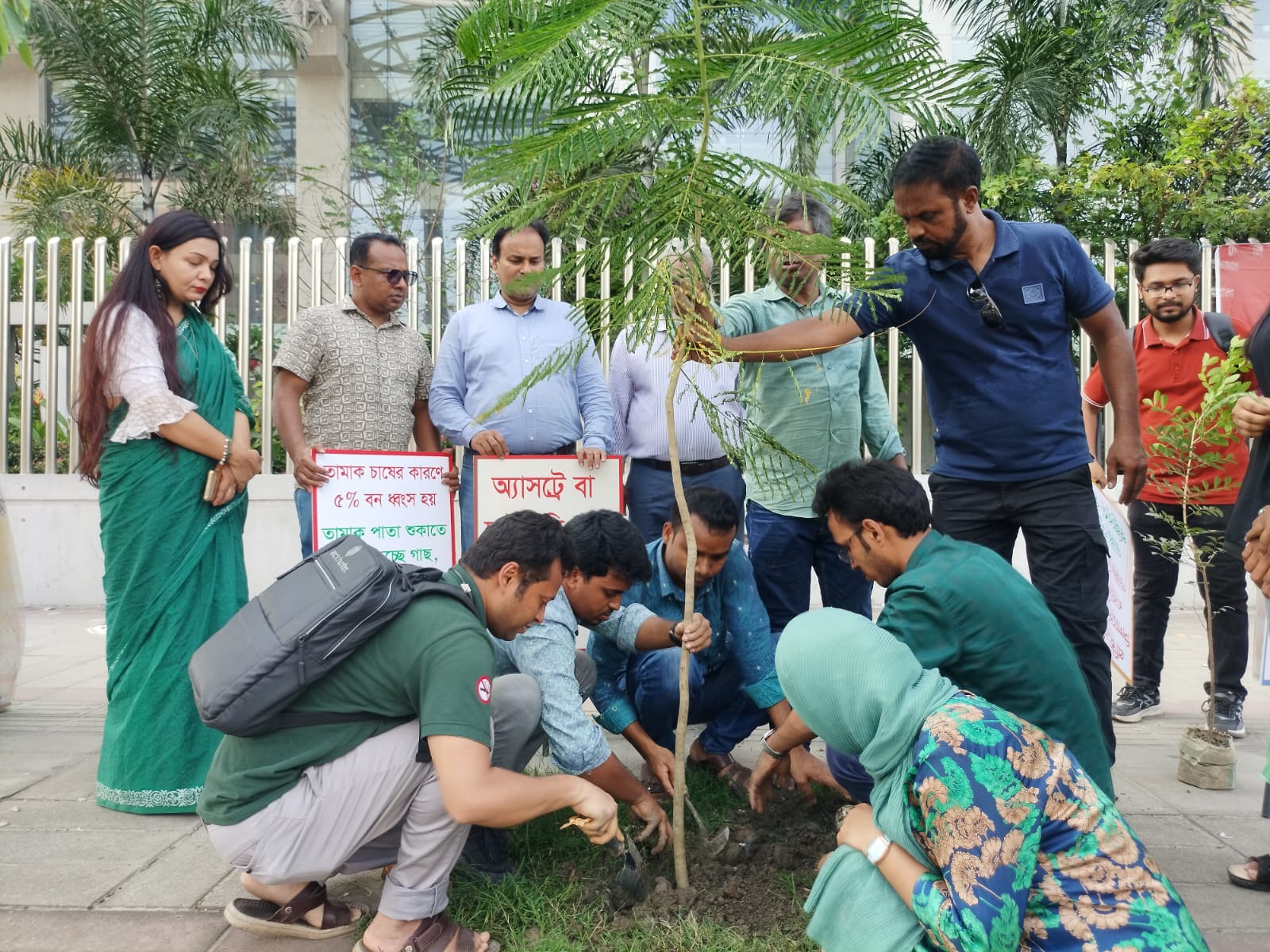
Public health experts have stated that public places should be for trees, not for smoking. They argue that cigarette companies are creating designated smoking areas to attract young people to smoking, which not only encourages them but also harms non-smokers. The experts claim that since the existing law allows for such spaces, cigarette companies are taking advantage of this opportunity.
This view was presented by public health experts at a special tree plantation program held on Saturday (July 12, 2025) in front of the National Board of Revenue in Agargaon, Dhaka. The event, organized under the slogan "No place for smoking in public places, a call for planting trees," was held to convey the message of planting trees for the protection of the environment and public health.
The program was jointly organized by the Bangladesh Anti-Tobacco Alliance (BATA), Aid Foundation, Bangladesh Network for Tobacco Tax Policy (BNTTP), Prottasha Anti-Drug Organization, CLPA, Dhaka International University's Tobacco Control and Research Cell (TCRC), DAS, NATAB, MANAS, Gram Bangla Unnayan Committee, Setu, and the WBB Trust.
Speakers at the event stated that the presence of "designated smoking areas" in restaurants and other public places allows smoke to spread, exposing non-smokers, including women and children, to the dangers of secondhand smoke. They pointed out that companies like British American Tobacco Bangladesh (BATB) and Japan Tobacco (JTI) are displaying their product signs, logos, and colorful lighting in these areas, which encourages young people to become addicted to tobacco. According to the Global Adult Tobacco Survey 2017, 43.9% of non-smokers have been exposed to secondhand smoke in various public places, with 49.7% of those incidents occurring in restaurants. A report by a research organization called Voice also found clear evidence of cigarette companies funding and being involved in creating these smoking zones.
The speakers further mentioned that environment-destroying tobacco companies are now wearing the mask of an 'eco-friendly institution' through 'forestation programs.' These so-called environmental initiatives are used as a branding strategy by tobacco companies. Although they plant trees in various locations, they typically choose fast-growing and environmentally harmful species. At the same time, they are encouraging tobacco cultivation, which destroys hills, arable land, and biodiversity—posing a serious threat to both the environment and human health. The public health experts welcomed the initiative to strengthen the tobacco control law but strongly condemned the interference of tobacco companies in this process.
The speakers added that despite the law prohibiting smoking in public places, there is a lack of effective implementation. They argued that the provision allowing for "designated smoking areas" acts as a major obstacle to public health. They stated that it is impossible to make public places 100% smoke-free until this provision is repealed. Instead, by allowing "designated smoking areas," the law is effectively legalizing secondhand smoking, which is a direct violation of the World Health Organization's Framework Convention on Tobacco Control (FCTC) of 2005 and a significant barrier to the government's goal of building a tobacco-free Bangladesh.
The tree plantation program was attended by officials and representatives from all the organizing institutions.

প্লিজ লগইন পোস্টে মন্তব্য করুন!
আপনিও পছন্দ করতে পারেন

- Jul 15, 2026
Massive Fire at Garment Factory Warehouse in...

- Jul 15, 2026
Wife Stabbed to Death in Gazipur Over Drug Mo...

- Jul 15, 2026
Deadly Robbery in Chandpur’s Shahrasti: House...

- Jul 15, 2026