- Nov 04, 2026
Digital Device Replaces Traditional Yellow Card in New Football Technology Trial
- Oct 17, 2026
- Sports
Staff Report | PNN
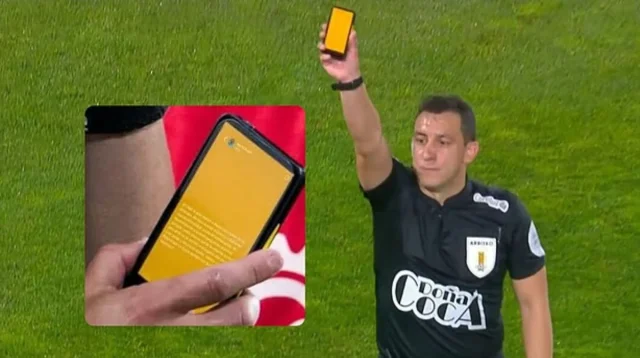
For decades, the sight of referees showing yellow and red cards to warn or penalise players has been a familiar part of football. Now, an attempt is underway to introduce technology into this long-established practice. During a football match in Uruguay, a referee used an electronic device resembling a mobile phone to caution a player instead of displaying the traditional yellow card. The new initiative has raised the possibility of changing how disciplinary cards are presented in football.
The device was tested on Thursday (October 15) during a Copa Uruguay match between Nacional and Rentistas. Referee Eduardo Varejao used the device, whose screen displayed a digital signal instead of a conventional card. However, the primary objective is not simply to change the way cards are shown. The technology is intended to digitally record information about disciplinary decisions made during a match in real time.
At present, after showing a player a yellow or red card, referees generally have to record the relevant details by hand. That information is subsequently entered into the designated digital system. The developers of the new device aim to simplify this process and reduce the time spent on administrative work.
The technology is being developed by a company called Refe. On Friday, the company’s director, Mauro Sacco, told Uruguayan radio station El Espectador Deportes that the team wanted to modernise the process of recording information after cards are issued, one of the tasks in football that is still performed using traditional methods.
Sacco and his co-director, Diego de la Pena, came up with the idea more than three years ago. While watching a football match in the rain, they noticed that referees still had to write down information by hand after making disciplinary decisions on the field. The information then had to be transferred to a digital system. Their search for an alternative to this lengthy process eventually led to the concept of digital cards.
The new device can record various incidents during a match along with their corresponding timestamps. It is expected to make it easier to submit official match information to the Uruguayan Football Association’s Comet platform.
Referee Varejao expressed satisfaction with the device after testing it during the match. He said it was easy to operate by hand and that its software responded quickly. However, he acknowledged that the new system lacked some of the immediate visibility and dramatic impact associated with raising a traditional yellow or red card.
Making the disciplinary signal clearly visible to spectators has emerged as a major challenge. During an earlier trial, the initiative had to be abandoned because the text or signals on the screen could not be seen properly in direct sunlight. Even during the latest match, some spectators in the stands and viewers watching on television reportedly struggled to understand the referee’s decisions.
Diego de la Pena, another director of the project, said work was underway to improve the device’s visibility and address these limitations. In his view, the device is easier to understand when seen directly at the stadium than when viewed on television. However, he acknowledged that the signals must be made clearer for both spectators and broadcasters.
The developers are considering several modifications, including adding LED lights around the device. Their goal is to ensure that the traditional yellow and red colours remain easily recognisable in the digital system and that the signals are clearly visible both inside the stadium and on television.
Sacco said the project’s brand had been registered and patents had been obtained for its hardware and software. A team based in China is also involved in its development.
After videos of the digital card being used circulated on social media, the technology became the subject of widespread discussion. Some have viewed it as a new step towards modernising football, while others have questioned whether it can effectively replace conventional cards. The trial has also inspired jokes and memes online.
Sacco, however, does not view criticism or humour as necessarily negative. He said new technologies inevitably attract different kinds of reactions when they are introduced. What matters, he explained, is that the initiative is generating discussion and creating opportunities to improve the technology further.
The project’s developers hope that, after the necessary improvements and trials, the system could receive recognition from the South American football governing body CONMEBOL and the global governing body FIFA. Whether the new method will eventually be introduced in international football will depend on its effectiveness, visibility and approval from the relevant authorities.
It is still too early to determine whether digital cards will eventually replace traditional yellow and red cards. For now, the technology remains an experimental initiative aimed at recording on-field decisions more quickly and making administrative tasks easier for referees.

প্লিজ লগইন পোস্টে মন্তব্য করুন!
আপনিও পছন্দ করতে পারেন


- Nov 04, 2026
Evidence of Sexual Harassment of Female Crick...

- Oct 31, 2026
Rain Halts West Indies' Run Chase; Visitors N...

- Oct 31, 2026
Portuguese Coach Miguel de Oliveira Nunes to...

- Oct 25, 2026