- May 20, 2026
Violence Breaks Out During Statehood Agitation in Ladakh
- Sep 24, 2025
- Exclusive
S. M. Arafath Habib | PNN International Desk
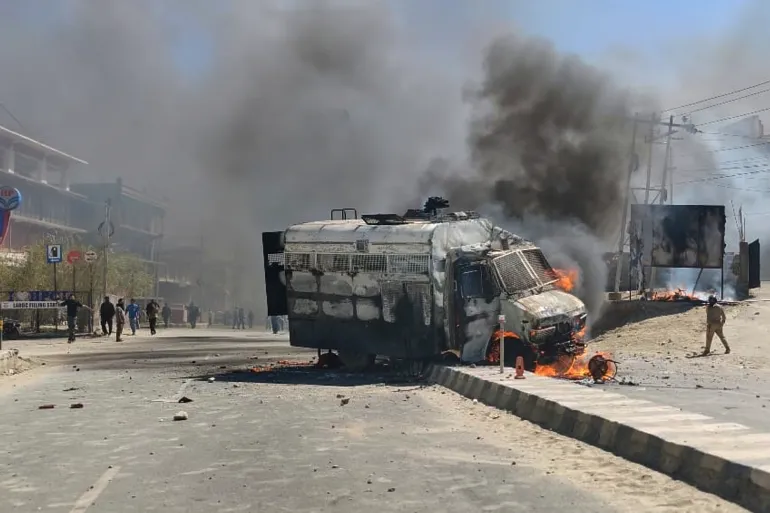
The ongoing movement in India’s Himalayan Union Territory of Ladakh, demanding statehood and constitutional rights, has turned violent. On Wednesday (September 24), clashes between protesters and police in Leh reportedly left at least four people dead and dozens injured, many of them critically.
Violent clashes and administrative action
According to police, demonstrators set fire to a paramilitary vehicle and the ruling Bharatiya Janata Party (BJP) office. Tear gas and baton charges were used to control the situation. Local sources claimed that several deaths were caused by gunfire, although the government has yet to officially confirm casualty figures.
Following the incident, Leh District Commissioner Romil Singh Dank imposed restrictions on gatherings of more than five people, protest rallies, and inflammatory speeches. Additional security has been deployed, and patrols have been intensified across the main town.
Core demands of the movement
In 2019, Prime Minister Narendra Modi’s government separated Ladakh from Jammu and Kashmir and declared it a Union Territory. Since then, locals have been agitating for constitutional safeguards and self-governance. Their main demands are:
- Inclusion under the Sixth Schedule of the Constitution: Ensuring special rights and autonomy for tribal areas.
- Priority in local employment: Preference for Ladakh residents in jobs and education.
- Local control over land and agriculture: Authority for local representatives instead of the central government in land and resource management.
- Environmental protection: Safeguarding the fragile Himalayan ecology from overdevelopment and militarization.
Youth leadership and momentum of protests
The movement has seen the most active participation from the youth. Recent shutdown programs in Leh, led by student and youth groups, drew widespread response. However, what began as peaceful demonstrations has gradually escalated into violence—an unusual phenomenon in Ladakh’s political culture. Analysts are calling it a “Gen-Z revolution.”
Sonam Wangchuk’s stance
Environmental activist and prominent leader of the movement, Sonam Wangchuk, ended his 15-day hunger strike on Wednesday. Expressing frustration after the violence, he said, “My message of peaceful resistance has failed. I urge everyone to refrain from violence—it only weakens our demands and our movement.”
Wangchuk, an engineer and educator, is internationally known for his work in sustainable technology, rural education, and eco-friendly innovation. Since the 1990s, he has run the “Students’ Educational and Cultural Movement of Ladakh (SECMOL),” which has made him an inspirational figure for the youth. Though not directly active in politics, he has become a frontline voice in Ladakh’s rights movement.
Political reactions
BJP leaders have dismissed the protests as opposition-driven. On the other hand, former Jammu and Kashmir Chief Minister Omar Abdullah alleged, “Because the BJP lost elections in this region, the people are being punished.”
Strategic importance and future talks
Bordering China, Ladakh holds immense strategic significance for India. In 2020, deadly clashes between Indian and Chinese troops occurred in the region, heightening bilateral tensions. Now, internal unrest adds further security concerns.
Despite several rounds of talks between the central government and Ladakh leaders in recent years, no resolution has been reached. A new round of negotiations is scheduled for October 6, and protesters are now awaiting the outcome.

Please Login to comment in the post!
you may also like

- Apr 26, 2026
EU AI Act: A New Standard for Trust, Safety,...
- Sep 04, 2025
Refugee Women in Sudanese Camp Cry Out: ‘Mone...

- Sep 03, 2025
Total Lunar Eclipse to Grace the Skies on Sep...
- Aug 12, 2025