

- May 02, 2026
International Desk | PNN:
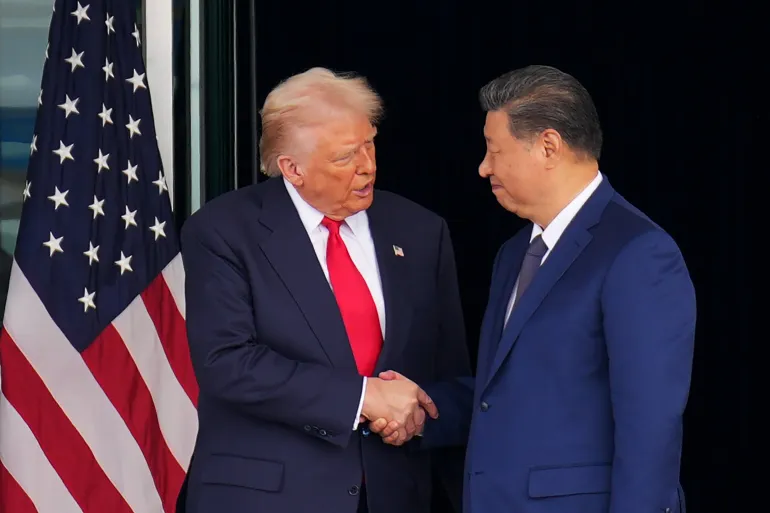
After five long years, U.S. President Donald Trump and Chinese President Xi Jinping met face-to-face and agreed to ease tensions in the ongoing trade war between their countries. The meeting took place on Thursday, 30 October 2025, on the sidelines of the Asia-Pacific Economic Cooperation (APEC) summit in Busan, South Korea, where both leaders agreed on a one-year truce in the trade war.
During the talks, China agreed to suspend its planned restrictions on rare earth exports for one year. In return, the U.S. withdrew its threat of imposing a 100 percent tariff on Chinese goods.
Additionally, Trump announced that if China takes active measures to curb illegal exports of the synthetic drug fentanyl, the U.S. would reduce fentanyl-related tariffs from 20 percent to 10 percent.
Trump said, “I believe President Xi will make the utmost effort to stop this deadly crisis.”
After a two-hour meeting, Trump described it as “an extraordinary meeting,” adding, “We resolved the complexities regarding rare earths. From now on, this will no longer be an obstacle.” He also noted that China committed to purchasing a significant amount of American soybeans.
Xi Jinping stated that the two countries had agreed to resolve various issues through dialogue and called for rapid, effective action.
China’s Ministry of Commerce later announced that not only would export controls be suspended, but the U.S. also agreed to suspend additional restrictions on technology-related exports. Both countries also agreed to waive reciprocal port fees.
The impact of the agreement on Asian stock markets was minimal. Indices in Hong Kong, Shanghai, and Sydney declined slightly, while Japan’s market remained almost stable.
Professor Dennis Wilder of Georgetown University commented, “This agreement is essentially a ceasefire. Both sides have put down their weapons, but haven’t abandoned them.”
Deborah Elms, head of the Singapore-based Hinrich Foundation, described it as “a partial pause or minor easing, but not a complete solution.”
Cameron Johnson, partner at Shanghai-based advisory firm TidalWave Solutions, said, “This truce is as practical as possible given the circumstances. Since Trump mentioned annual reviews, it creates an opportunity to maintain balance in bilateral relations.”
China’s planned restrictions on rare earths had raised fears of global supply disruption, as these minerals are essential for producing modern technologies, from smartphones to fighter jets.
Economists noted that while the agreement has somewhat eased tensions between the two countries, the core structures of tariffs and export controls remain intact. Therefore, while the global economy experiences temporary relief, uncertainty still lingers.