- Jul 15, 2026
Political Parties Reach Consensus: New Provisions Coming for State of Emergency and Chief Justice Appointment
- Jul 14, 2025
- Politics
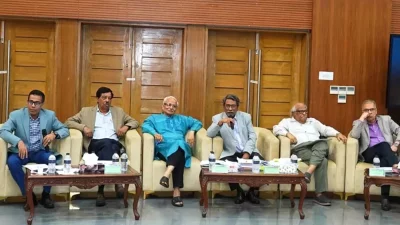
Political parties have reached a consensus on the methods for declaring a state of emergency and appointing the Chief Justice. New provisions will be added to the constitution for these two areas. This decision was made yesterday, Sunday, during discussions between political parties and the National Consensus Commission.
Under the new provisions for declaring a state of emergency, the President will impose it with the approval of the cabinet. The Leader of the Opposition, or their deputy in their absence, will be required to participate in this cabinet meeting. The term "internal disturbance" currently used in the constitution will be replaced with phrases such as "threat to state independence, sovereignty, territorial integrity, or due to epidemic or natural disaster." It has also been agreed that certain fundamental rights, such as the right to life and the fundamental rights outlined in Article 35 concerning justice and punishment, cannot be suspended even during an emergency.
Regarding the appointment of the Chief Justice, the decision is that the President will appoint the senior-most judge of the Appellate Division as the Chief Justice. However, if any political party explicitly states in its election manifesto that it will appoint the Chief Justice from among the two senior-most judges, and if they come to power, they can amend the constitution accordingly. Furthermore, a judge against whom an investigation is ongoing cannot be appointed as Chief Justice.
Professor Ali Riaz, Vice President of the National Consensus Commission, provided these details to journalists after the discussions.
Meanwhile, yesterday, the National Consensus Commission presented a combined proposal regarding the framework for a caretaker government. Concurrently, BNP Standing Committee member Salauddin Ahmed also put forward a new proposal, which includes five alternatives for appointing the Chief Adviser.
BNP's proposal suggests that the President would first attempt to appoint the Chief Adviser through discussions with parliamentary parties. If that is not possible, an alternative committee comprising the Prime Minister, Leader of the Opposition, Speaker, and Deputy Speaker would be formed, chaired by the President (without voting rights). The proposal outlines further alternatives if consensus remains elusive, ultimately suggesting a return to the provisions of the Thirteenth Amendment as a final option. In this latter scenario, all parties generally agreed that the President should not be part of the caretaker government, though it could be considered as a last resort.
These proposals were not discussed in detail yesterday. Jamaat-e-Islami and several other parties raised objections to BNP's proposal, pointing out flaws. Other political parties wishing to submit proposals on the caretaker government framework have been asked to do so in writing to the Commission by 10:00 AM today, Monday. A detailed discussion on this matter is scheduled for tomorrow, Tuesday.

প্লিজ লগইন পোস্টে মন্তব্য করুন!
আপনিও পছন্দ করতে পারেন

- Jul 15, 2026
Failure in Education and Employment Leadershi...
- Jul 15, 2026
Government Will Take Steps to Rehabilitate Fl...

- Jul 15, 2026
Awami League’s Surprise Procession on Dhaka–A...
- Jul 11, 2026