- Nov 04, 2026
July History Must Not Be Presented as the Sole Narrative of Any Political Party; Full History Must Be Preserved: Nahid Islam
- Aug 08, 2026
- Politics
PNN News Desk, Dhaka
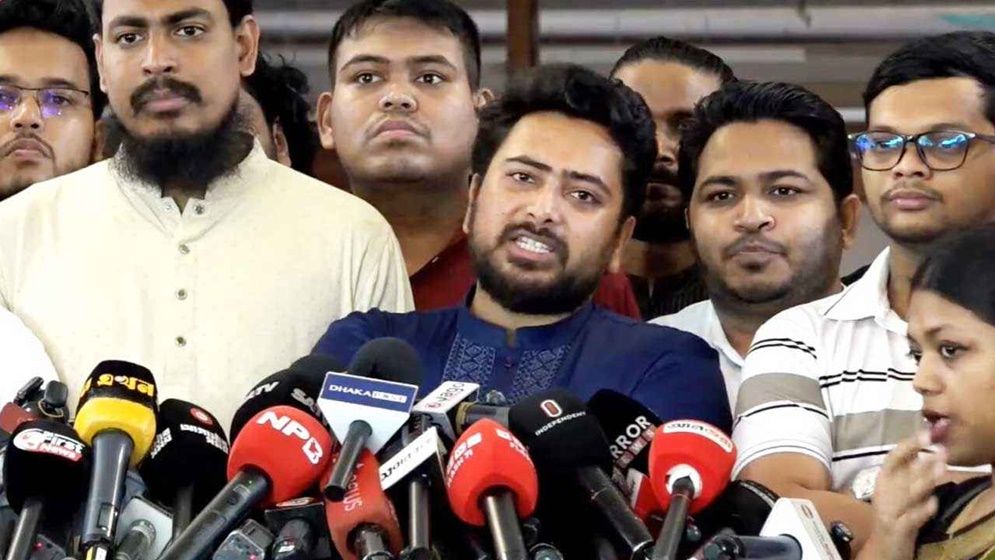
Nahid Islam, convener of the National Citizen Party (NCP) and chief whip of the opposition, has called for preserving the authentic and complete history of the July mass uprising without limiting it to the narrative of any particular political party or group.
He made the remarks while speaking to journalists after visiting the July Mass Uprising Memorial Museum at Ganabhaban in the capital on Saturday (August 8) morning.
Nahid Islam said the July Mass Uprising Memorial Museum should be developed not merely as an exhibition venue but as an important center for the study and preservation of national history. He said there should be no reflection of any partisan version of history at the museum.
Commenting that certain individuals and events in the museum's current exhibition have received comparatively greater prominence, he said the broader scope of the July uprising and the participation of people from different professions, social classes and regions across the country should be highlighted more extensively. He suggested that events of the movement be arranged chronologically and that the roles of private universities, madrasas, universities outside Dhaka and different districts be highlighted separately.
Nahid Islam said it is important to learn from past experiences when preserving the history of July. He noted that there had previously been allegations of politicization of the history of the Liberation War, while textbooks and historical narratives had also changed with changes in government. He said care must be taken to ensure that the same situation is not repeated in the case of July.
According to him, history must be preserved and presented in such a way that the people of the country can embrace it as their own history. At the same time, the truth of history must not be altered to serve the interests of any political party.
The NCP leader also expressed concern over the management and security of the museum. He said the museum currently does not have enough staff to handle the large number of visitors. While around 200 employees are needed, only 15 to 20 people are currently working there. As a result, the museum's activities are being conducted with limited manpower and the assistance of volunteers. He warned that this could create risks in terms of security and management.
He also stressed the need to appoint trained personnel to properly explain the museum's artifacts and the history associated with them to visitors.
Nahid Islam called for involving experts associated with history, research and the July Mass Uprising in the management of the museum instead of relying solely on a bureaucratic structure. In his view, the necessary laws and institutional arrangements should be developed to operate the museum under an autonomous framework.
He said students, researchers, political activists and people from various professions played important roles during July, and the experiences of those who were involved with the museum's work from the beginning should be utilized.
Nahid Islam also spoke about the memory of martyr Abu Sayed, one of the most prominent symbols of the July Mass Uprising. He said the authorities had been informed that Abu Sayed's photograph is currently absent from the museum's exhibition. According to him, the authorities said they were planning to produce a film about Abu Sayed and would take steps to screen it at the museum.
He called for a broader display of memorabilia collected from the families of the martyrs. According to him, although some memorabilia are currently on display, there are many more artifacts that could be presented to visitors in a planned and artistic manner.
Nahid Islam also suggested expanding the museum's scope by utilizing the nearly 17 acres of land at Ganabhaban. He believes there is an opportunity to present a much wider range of events, memories and artifacts associated with the July Mass Uprising there.
He also questioned the exclusion of various events, including border killings and anti-India movements, from the history of July. In his view, these events should also be properly preserved and displayed as part of the historical record.
Nahid Islam said the museum should also document the political, economic and social damage suffered by the country over the past 16 years, alongside the resistance and victories of ordinary people. According to him, it is impossible to construct a complete history by leaving out certain events.

Please Login to comment in the post!
you may also like
- Nov 04, 2026
Workers' Movement Is Justified, Government Re...
- Nov 04, 2026
Government Has Failed to Address People's Pro...
- Nov 03, 2026
Jamaat Leader Akhtaruzzaman Released from Jai...
- Nov 03, 2026