- Apr 26, 2026
Crimes Get Publicity, Justice Does Not
- May 20, 2026
- Exclusive
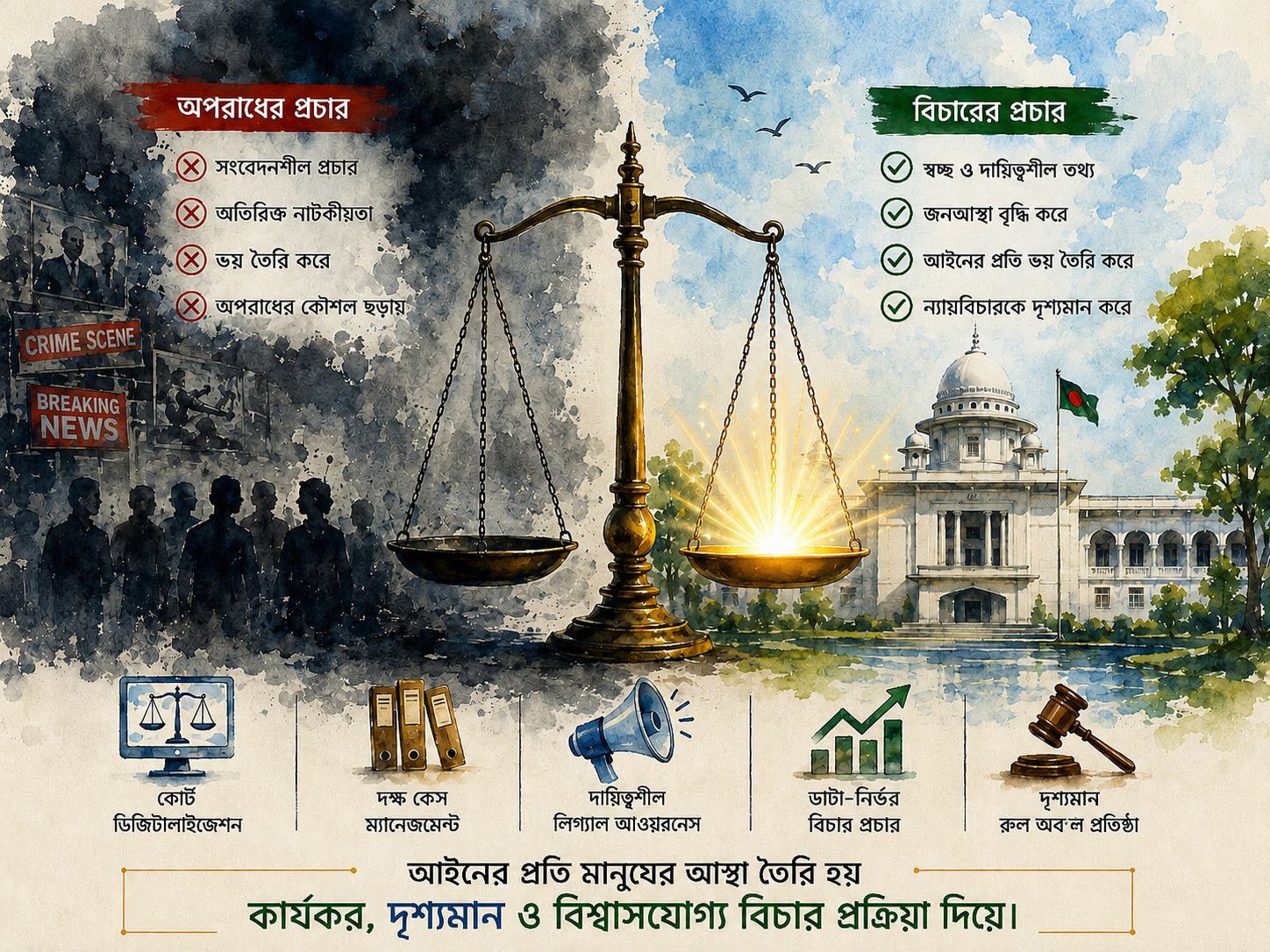
From my limited knowledge of law, I can say one thing: there is not much deficiency in Bangladesh’s laws when it comes to punishing criminals. For example, the Women and Children Repression Prevention Act, 2000 contains provisions such as the death penalty or rigorous life imprisonment for crimes like the rape of women and children.
Then why is there still so much fear, frustration, and distrust among ordinary people regarding the justice system?
In my observation, there are at least two major reasons behind this.
1. Lack of speed, efficiency, and modernization in the judicial process:
Bangladesh’s theoretical laws are strong in many cases. But the problems begin in the investigation, case management, and lengthy judicial process. Repeated court dates, delays, weak investigations, technological backwardness, and inefficient management reduce people’s confidence in the system. A few days ago, I saw a woman who, while pursuing justice for her murdered son, had sold all her land and property and is now surviving by begging.
Justice being delivered alone is not enough. Justice must also be visible, timely, and effective. While it is true that proper justice requires time, it is equally true in many cases that Justice delayed is Justice denied.
2. Crimes receive publicity, but justice does not:
Whenever a horrific crime occurs in Bangladesh, it receives massive publicity. But ordinary people rarely get to know about the follow-up of the case — the investigation, charge sheet, witness testimonies, verdict, or punishment.
As a result, society develops a perception:
“Crimes happen, but justice does not.”
In reality, punishments are being handed down in many cases every day. But that information does not reach the public. There is not even any accessible database for ordinary citizens on this matter.
This has major negative social impacts, such as:
People lose confidence in the justice system
Criminals become less afraid of law enforcement
The Rule of Law does not remain visible in society
In today’s modern age of information flow, one thing is truly important:
“Publicity creates expansion.”
Even in the state’s justice system, Responsible Public Legal Communication is no longer a luxury — it is now an urgent necessity.
However, I strongly oppose so-called “Crime Patrol”-type sensational crime content. Because many times such content popularizes criminal techniques more than it prevents crime.
With time, what we need are:
Digitalization of the court system
Efficient case management and data-driven judicial systems
Responsible legal awareness programs
Transparent updates on judicial proceedings
And visible Rule of Law established among the people
People’s trust in law is not built merely through thick and difficult law books.
It is effective, visible, and trustworthy judicial processes that build that confidence.
(The opinions expressed are solely those of the author.)
Author:
Khandker Shamim
Human Rights Activist and Columnist
Co-founder and President of PATH Bangladesh

প্লিজ লগইন পোস্টে মন্তব্য করুন!
আপনিও পছন্দ করতে পারেন


- Sep 24, 2025
Violence Breaks Out During Statehood Agitatio...

- Sep 04, 2025
Refugee Women in Sudanese Camp Cry Out: ‘Mone...

- Sep 03, 2025
Total Lunar Eclipse to Grace the Skies on Sep...
- Aug 12, 2025