- May 02, 2026
Chinese investment to establish a military drone factory in Bangladesh sends strategic signal in South Asia
- Jan 15, 2026
- International
Staff Reporter | PNN
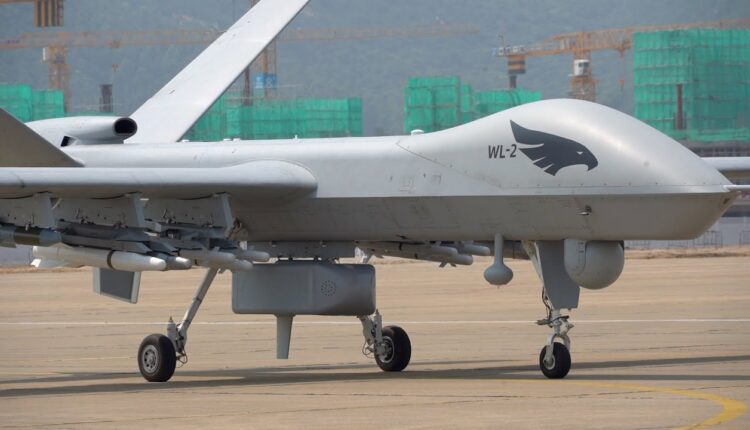
The decision to establish a military drone production factory in Bangladesh has added a new dimension to South Asia’s defense and geopolitical landscape. With an estimated cost of Tk 6.08 billion and Chinese assistance, the project is expected to make Beijing’s influence more visible within the Bay of Bengal–centric security framework, analysts believe.
Approved by the Ministry of Finance, the government-to-government (G2G) agreement will be implemented by the Bangladesh Air Force. Technology will be supplied by China’s state-owned China Electronics Technology Group Corporation (CETC), which is globally known for radar systems, electronic warfare equipment, and drone technology.
The official name of the project is “Establishment of Unmanned Aerial Vehicle (UAV) Production Factory and Technology Transfer.” Of the total cost, approximately Tk 5.70 billion will be spent on importing machinery and technology. In the current fiscal year, around Tk 1.06 billion has been allocated for the first phase.
Although no specific drone model has been mentioned in official documents, defense analysts believe the factory is being prepared mainly to produce China’s Wing Loong-2 class medium-altitude long-endurance (MALE) armed drones. These drones are widely used internationally due to their surveillance and strike capabilities.
The news of implementing this project in Bangladesh has raised concern among Indian policymakers. In particular, the presence of Chinese military technology in Bangladesh, close to India’s northeastern region, is believed to pose a challenge to New Delhi’s strategic comfort.
The issue is also politically significant. After the change of government in 2024, interim government Chief Adviser Professor Muhammad Yunus strengthened economic and defense cooperation with China. During his visit to China in March 2025, several major agreements were signed, following which the initiative to establish this drone factory was taken.
Md. Obaidullah, a faculty member of the Department of International Relations at Daffodil International University, said, “As India has failed to provide effective alternatives to meet Bangladesh’s defense needs, Bangladesh is leaning toward China.” He added that instead of merely raising objections, proposing joint initiatives could be a more realistic path for India.
When asked about the government’s position, Economic Adviser Salehuddin Ahmed declined to comment, saying that necessary information would be shared once everything is finalized.
Analysts believe this factory is not merely an industrial project; rather, it signals a redefinition of Bangladesh’s defense capability, technological self-reliance, and strategic positioning. At the same time, it is a clear example of how competition among major powers in the Indo-Pacific region is affecting Bangladesh as well.
The project is expected to become operational by 2026. Observers are now keen to see what impact this initiative will have on regional security and the balance of power.

প্লিজ লগইন পোস্টে মন্তব্য করুন!
আপনিও পছন্দ করতে পারেন

- May 02, 2026
China calls for reconsideration of UN peaceke...

- Apr 30, 2026
New discussion on EU joint defense clause ami...

- Apr 30, 2026
Israeli forces block aid convoy in internatio...
- Apr 30, 2026