- Jun 20, 2026
Breakthrough in London Meeting Eases Political Deadlock: Road to Election Becomes Clearer
- Jun 14, 2025
- Politics
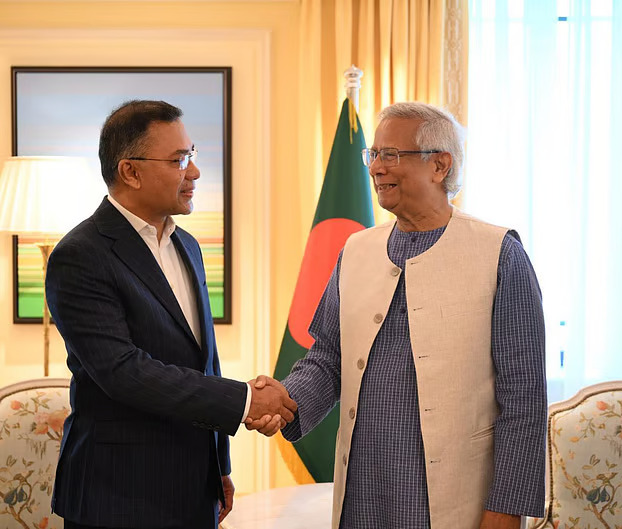
The long-standing political uncertainty surrounding Bangladesh's 13th National Parliamentary Election appears to be easing, following a high-profile meeting in London. The nearly 90-minute discussion between Professor Muhammad Yunus, Chief Advisor of the interim government, and Tarique Rahman, Acting Chairman of the BNP, provided a clear outline for a possible election timeline, creating a sense of relief and optimism across the nation.
Held on Friday at 9:00 AM (London time) at the Dorchester Hotel, the primary agenda of the meeting was to determine a feasible timeframe for the upcoming general election. In a joint statement following the talks, both parties signaled that elections could be held by early February next year, ahead of the holy month of Ramadan, provided all preparations are completed. Analysts view this development as a potential end to weeks of speculation and political instability.
Previously, in a public address before Eid in June, Professor Yunus had indicated April 2026 as a tentative timeframe for the election, which the BNP opposed, instead calling for elections by December 2025. In this context, Friday’s meeting takes on great significance, with observers interpreting it as a step toward consensus.
The joint statement has been welcomed by several political parties and coalitions, who praised the initiative as a “positive breakthrough.” Professor Asif Nazrul, Legal Advisor to the interim government, termed it “a significant advancement,” adding,
“Professor Yunus has demonstrated wisdom, while Tarique Rahman has shown mature leadership.”
However, not everyone expressed satisfaction. Jamaat-e-Islami, Islami Andolan Bangladesh, and the National Citizens' Party (NCP) raised concerns over the joint declaration, arguing that a broader inclusive announcement involving all political parties would have been more appropriate. The NCP also insisted that without a roadmap for implementing the July Accord and judicial reform, any agreement would remain incomplete.
During the meeting, Professor Yunus and Tarique Rahman held a private one-on-one discussion. Later, National Security Advisor Khalilur Rahman, BNP leader Amir Khosru Mahmud Chowdhury, and other representatives addressed the media with a joint press statement, confirming that both sides are in principle agreement to hold the election by February. However, the statement emphasized that “meaningful progress in judicial and institutional reforms” must accompany the electoral timeline.
In the press briefing, Amir Khosru said:
“We are committed to working together before and after the election to build a new Bangladesh.”
He did not provide specifics on the July Accord or Election Commission reform, while Khalilur Rahman stated that the Election Commission is expected to announce a date soon.
From Dhaka, BNP Secretary General Mirza Fakhrul Islam Alamgir, speaking from the party’s Gulshan office, described the meeting as “historic.” He mentioned that Tarique Rahman called him after the meeting, congratulated party leaders and workers, and expressed gratitude toward Begum Khaleda Zia.
Fakhrul stated,
“At a time when the nation was drifting into uncertainty, these two leaders have brought back hope and a sense of possibility.”
Although the joint statement did not directly mention Tarique Rahman's return to Bangladesh or any formal legal action against Prime Minister Sheikh Hasina, the inclusion of "progress in justice and reform" is widely interpreted as a signal toward future developments.
Political analysts suggest that this joint message between the interim government and opposition leadership could mark not just a resolution to the election timeline but a significant turning point in Bangladesh’s overall political landscape.
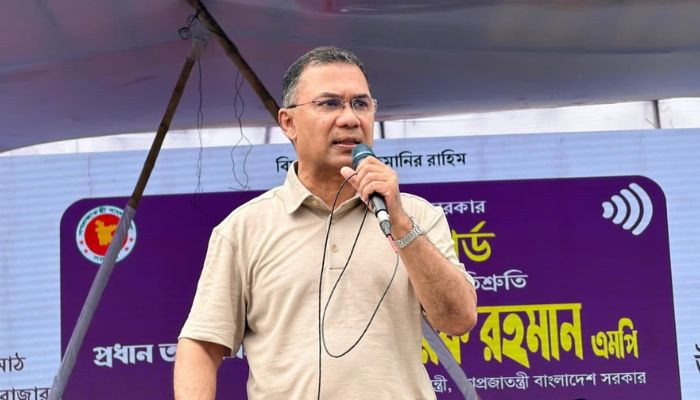
Photo: Collected

প্লিজ লগইন পোস্টে মন্তব্য করুন!
আপনিও পছন্দ করতে পারেন

- Jun 20, 2026
Nationwide security tightened over possible t...
- Jun 20, 2026
Maulana Mamunul Haque announces nationwide ca...
- Jun 18, 2026
Jamaat MP Demands Household Facilities in Par...
- Jun 18, 2026