- Jul 25, 2026
Thousands of Families in Yemen's Taiz Continue Living Under the Constant Threat of Snipers
- Jul 25, 2026
- International
International Desk | PNN
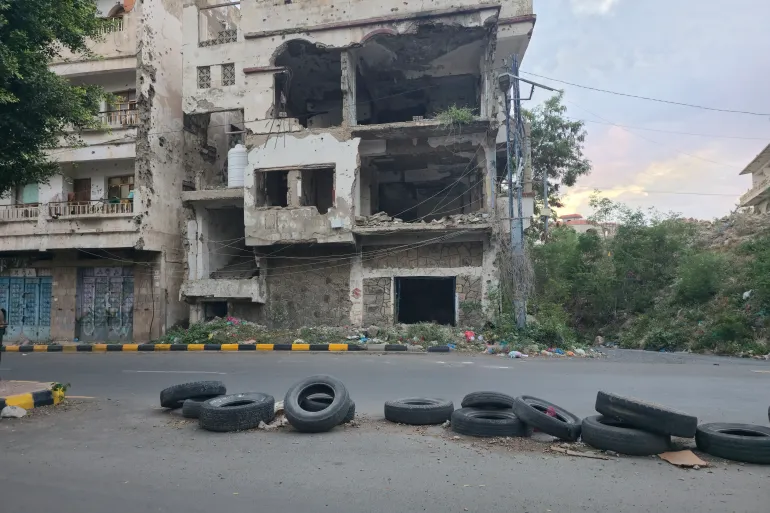
Although the intensity of Yemen's decade-long war has eased compared with previous years, daily life in the frontline neighborhoods of Taiz City remains marked by uncertainty, fear, and a constant struggle for survival. A shortage of safe housing and soaring rental costs have forced many families to live in areas where a single misstep could prove fatal.
One such resident is "Umm Yousuf," a pseudonym used to protect her identity. The woman, a single mother in her forties, has spent years searching for a safe place to raise her four children. After her husband died several years ago while working abroad, she became the family's sole breadwinner.
However, due to worsening poverty and the housing crisis in war-torn Yemen, renting a three-room house in a safer neighborhood became financially impossible. After searching unsuccessfully for affordable accommodation for eight months, she eventually moved into a house close to the frontline, where the monthly rent was only $13.
That affordable decision soon turned into a terrifying reality.
In January 2025, only two months after moving into the new home, her 11-year-old son was shot while playing outside. The child returned home bleeding heavily from his mouth.
Umm Yousuf said she never heard the sound of a gunshot. Later, it was believed that her son had been struck by a sniper's bullet fired from a distant position.
Doctors managed to save the boy's life after he was rushed to hospital. Although he was discharged the following day, the incident made the entire family realize the extreme danger surrounding them.
Despite the risks, they cannot afford to relocate.
According to Umm Yousuf, local residents have adopted various survival strategies. At night, they switch off lights that could be visible from a distance. Children are forbidden from playing in open spaces and instead play only in areas shielded by buildings.
She said she knew nothing about such precautions before moving there, but now follows the same practices as her neighbors in an effort to protect her children.
According to a United Nations monitoring report, 66 percent of all civilian sniper casualties in Yemen last year occurred in Taiz. Of the 21 documented sniper incidents, nine victims were children.
Analysts say Taiz's mountainous landscape provides ideal positions for snipers. Elevated locations throughout the city offer clear lines of sight toward residential neighborhoods, creating a continuous threat to civilians.
Khaled Alwan, Director of the Statistics Office in Taiz Governorate, said that more than 10,000 homes have been completely or partially damaged during the conflict. Many additional damaged buildings have yet to be officially documented.
He explained that although houses remain standing in relatively safer areas, most families cannot afford the cost of repairing them, further worsening the housing shortage.
Some humanitarian organizations have assisted with rehabilitation projects. Through cooperation between the Nahda Makers Organization (NMO) and the United Nations High Commissioner for Refugees (UNHCR), several thousand homes have been restored. However, the number remains far below the needs of the millions displaced across Yemen.
Another resident, Mohammed Saeed, 53, who lives in Taiz's Al-Thawrah district, represents another face of the conflict.
Unable to pay rent because he is unemployed, he now lives with his family in an abandoned house in exchange for guarding the property.
He said gunfire frequently wakes the family during the night. At first, his children would cry in fear whenever they heard shooting.
"Now they have become used to it," he said, "but no child should ever have to grow accustomed to something like this."
Meanwhile, accountant Khaled Abdulhadi left his home after the war began and relocated to a safer neighborhood. Although he still owns a house in Taiz, he continues living in rented accommodation.
He said some of his neighbors who returned to their homes were later killed by sniper fire. For that reason, he has no intention of moving back despite leaving his own property vacant.
Instead, he has allowed a poor family to live there rent-free in exchange for looking after the house.
As he put it, "The war has taken so much from us. Now, the most valuable thing is life itself. Protecting it has become our greatest responsibility."
Although the pace of fighting has slowed across Yemen, insecurity continues to dominate everyday life. For countless families in Taiz, a safe home is no longer merely a place to live—it has become the greatest dream for survival.

প্লিজ লগইন পোস্টে মন্তব্য করুন!
আপনিও পছন্দ করতে পারেন

- Jul 25, 2026
India's Education Minister Resigns Amid Press...

- Jul 23, 2026
U.S. Investigates Possible Russian Role in Ir...

- Jul 23, 2026
Modi Announces Fast-Track Courts to Tackle Ex...

- Jul 23, 2026