
- May 02, 2026
International Desk | PNN:
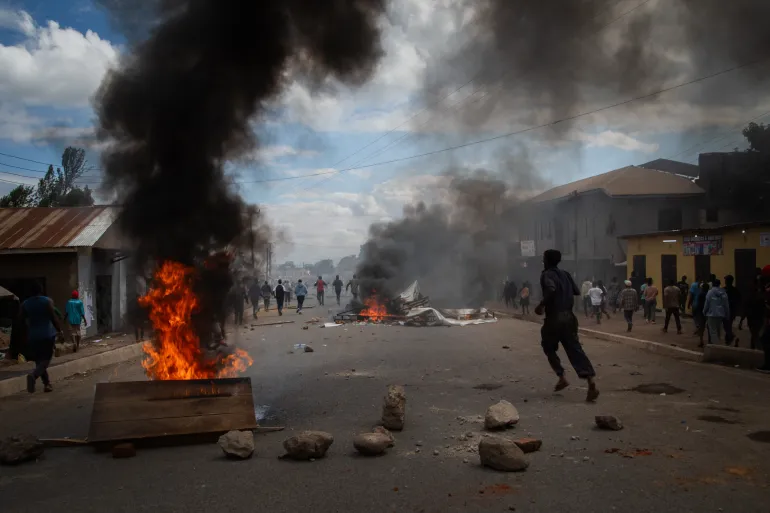
Tanzania remains on edge as violent protests continue for the third consecutive day in several cities, including the commercial capital Dar es Salaam, over a disputed national election. As of Friday morning (October 31), protesters clashed with police, prompting the government to deploy the army and impose an internet blackout to contain the unrest.
The turmoil that began around Wednesday’s election escalated sharply on Thursday night. In the capital’s Mbagala, Gongo la Mboto, and Kiluvia areas, thousands of people defied a curfew and took to the streets, forcing police to disperse the crowds with tear gas. Local media reported hearing gunfire in some neighborhoods.
According to Amnesty International, at least two people have been killed in this week’s violence. Protesters have been demanding a halt to the announcement of election results, staging sit-ins on the streets, and setting fire to vehicles, a fuel station, and police posts in several areas.
In Wednesday’s general election, the ruling Chama Cha Mapinduzi (CCM) party — in power continuously since 1961 — sought to maintain its dominance. However, the disqualification of two main rivals to President Samia Suluhu Hassan sparked widespread outrage across the country.
The main opposition party CHADEMA was disqualified in April after refusing to sign the election code of conduct. Its leader, Tundu Lissu, was arrested on treason charges while calling for electoral reforms during a public rally. Meanwhile, Luhaga Mpina, candidate of the Alliance for Change and Transparency (ACT-Wazalendo), was barred from running following objections from the Attorney General.
A report by nine UN experts stated that since 2019, Tanzania has seen over 200 politically motivated disappearances. In September, Human Rights Watch warned that October’s election was “at serious risk,” citing at least 10 incidents of political attacks, abductions, torture, and media repression.
The ongoing violence has drawn international concern, with the United Nations and human rights organizations urging the Tanzanian government to end its crackdown on dissent and ensure a free and transparent electoral process.
Meanwhile, in the semi-autonomous islands of Zanzibar, the local election commission announced that CCM candidate Hussein Mwinyi was re-elected with 78.8% of the vote. Opposition parties, however, denounced the results as “massive fraud” and threatened to announce further protest programs.
As the unrest intensifies, the government has postponed the reopening of colleges and universities, originally scheduled for next Monday. Army Chief Jacob John Mkunda stated on Thursday, “The military will work in coordination with law enforcement agencies to maintain national stability.”
A heavy presence of military and police forces has been reported across Dar es Salaam and other regions. Analysts say Tanzania’s political crisis has now joined a growing list of African nations facing prolonged power struggles and authoritarian entrenchment.