- Apr 19, 2026
Student strike against immigration raids across the US, large protests in Minneapolis
- Jan 31, 2026
- International
International Desk, PNN
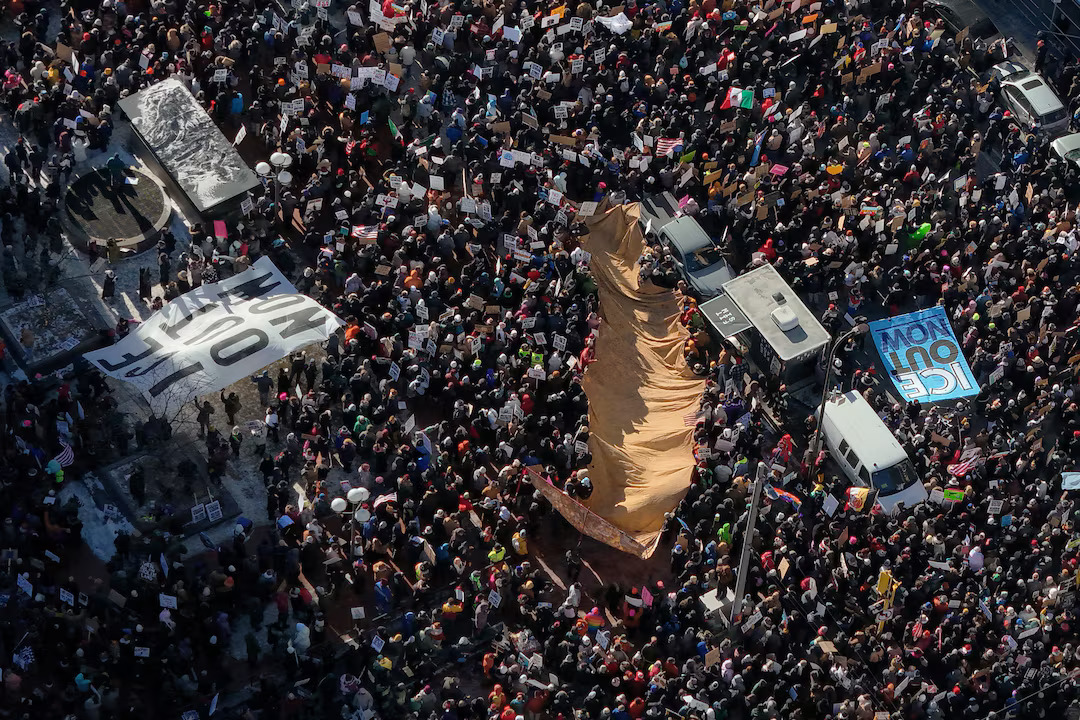
In Minneapolis, United States, thousands of people took to the streets on Friday, braving severe cold. The demonstrations were held demanding a halt to federal immigration raids in Minnesota. Students across various states also boycotted classes to participate in nationwide protests.
The protests intensified following the recent deaths of two US citizens in shootings by federal immigration agents in Minneapolis. On the day of the protest, teachers and students from schools in California to New York refrained from attending classes to voice their opposition.
Under President Donald Trump’s strict immigration policies, nearly 3,000 federal officers were deployed in the Minneapolis area. The number of officers in tactical gear was about five times the size of the local police force. This increased activity of US Immigration and Customs Enforcement (ICE) angered local residents.
Despite sub-zero temperatures, several thousand people gathered downtown Minneapolis. Protesters included families with young children, elderly couples, and young workers. Many carried placards demanding that ICE leave the city.
A protester, Katia Kagan, said her parents came to the US seeking safety and a better life. She explained that she joined the protest to protect the “American Dream.” A 65-year-old meditation instructor described the operation as a totalitarian attack by the federal government on citizens.
In the area where the two citizens, Alex Pretty and Renny Good, were killed, nearly 50 school teachers and staff marched.
The protests spread beyond Minnesota to 46 other US states. Organizers reported about 250 protest events in major cities such as New York, Los Angeles, Chicago, and Washington. The slogan was: “No work, no school, no shopping—stop funding ICE.”
The Minneapolis incident also impacted the federal administration. The acting head of the FBI’s Minneapolis field office, Jared Smith, was removed from his position and reinstated in Washington. The office had been involved in sensitive investigations alongside the ICE operations.
Further controversy arose when the New York Times reported, citing internal documents, that ICE officers’ authority to arrest people without warrants had increased, allowing lower-level officers to conduct immediate operations against suspected undocumented immigrants.
Trump’s immigration policies also influenced Congress. Democrats opposed funding for the Department of Homeland Security, creating fears of a partial government shutdown.
A recent Reuters-Ipsos survey showed that public support for Trump’s immigration policy reached the lowest level of his second term after ICE operation videos circulated on social media. Minnesota Governor Tim Walz stated that halting the strict operation and withdrawing federal forces was the only way to ensure public safety in the state. Meanwhile, President Trump indicated some restraint in the operations but clarified that they would not be completely stopped.

প্লিজ লগইন পোস্টে মন্তব্য করুন!
আপনিও পছন্দ করতে পারেন


- Apr 19, 2026
North Korea fires multiple ballistic missiles...
- Apr 19, 2026
Israel announces new “Yellow Line” in souther...
- Apr 19, 2026
Progress in US–Iran talks, but agreement stil...

- Apr 16, 2026