- Jul 01, 2026
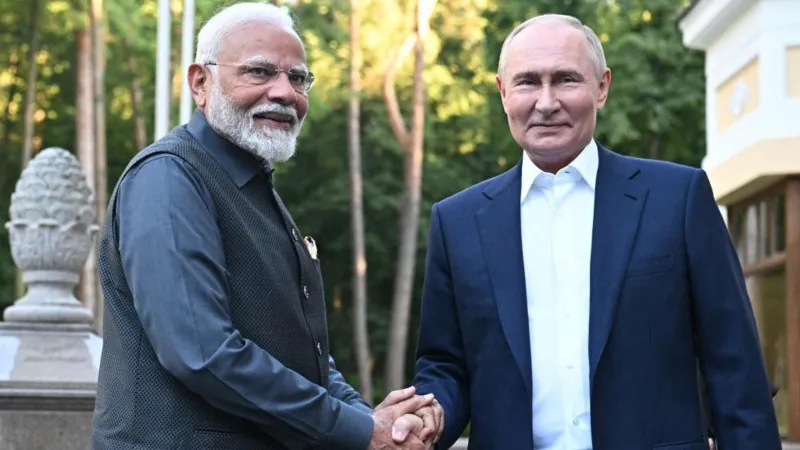
New diplomatic equation around Modi-Putin meeting
- Dec 04, 2025
- International
International Desk | PNN
Russian President Vladimir Putin has arrived in New Delhi today for a two-day state visit. During this visit, he will hold the annual summit with Indian Prime Minister Narendra Modi, where several important agreements on energy, defense, and trade cooperation are expected to be signed.
India-Russia relations have a long history spanning several decades. However, this summit holds extra significance because trade tensions between Washington and Delhi are increasing, while at the same time Russia is seeking new markets under Western sanctions.
Russia’s oil market has become limited in Europe, making India one of its largest buyers. Before the Ukraine invasion, only 2–3% of India’s total crude oil imports depended on Russia, but after the war started, this increased severalfold. However, recent U.S. administration imposition of an additional 25% tariff has reduced imports somewhat. Putin wants India to remain a stable buyer in Russia’s energy market as before.
The defense sector will also be a major part of the discussion. India’s military has long relied on Russian technology for its primary platforms. Although India has been exploring alternative sources in recent years, key capabilities—from Sukhoi-30 fighter jets to the S-400 air defense system—still depend heavily on Russian supplies.
Sources say India has expressed interest in acquiring upgraded S-500 systems and fifth-generation Su-57 fighter jets, as part of a strategy to counter Pakistan’s new J-35 stealth fighters.
For Modi, this visit is a test of diplomatic balance. On one hand, he wants to maintain traditional ties with Russia, and on the other, he cannot ignore pressure from the U.S. and European partners.
The Modi government wants Delhi’s decisions to reflect “strategic autonomy,” prioritizing India’s national interest without blindly aligning with any side.
Recently, three European ambassadors criticized Russia’s wartime actions in a joint article, sending a clear signal of increased Western diplomatic pressure on India.
By March 2025, India-Russia bilateral trade reached around $69 billion, largely dependent on oil imports. India is concerned about the resulting trade deficit. Delhi wants to increase Indian goods’ access to Russian retail and industrial sectors. While there is potential in food, clothing, electronics, and consumer products, India’s presence remains limited.
According to policymakers, even a moderate outcome from this summit would stabilize energy and defense cooperation. If the two countries reach a more ambitious agreement, it could bring significant changes to regional economy and strategic balance.
প্লিজ লগইন পোস্টে মন্তব্য করুন!
আপনিও পছন্দ করতে পারেন
- Jul 01, 2026
Pakistan–Afghanistan Border Tensions Escalate...
- Jul 01, 2026
UN Seeks $100 Million to Support Palestinian...
- Jun 27, 2026
Thai Police Arrest Australian Citizen After T...

- Jun 27, 2026