- Jul 03, 2026
Israel’s Policy of Starvation and Massacre in Gaza: People Dying in Search of Aid
- Aug 02, 2025
- International
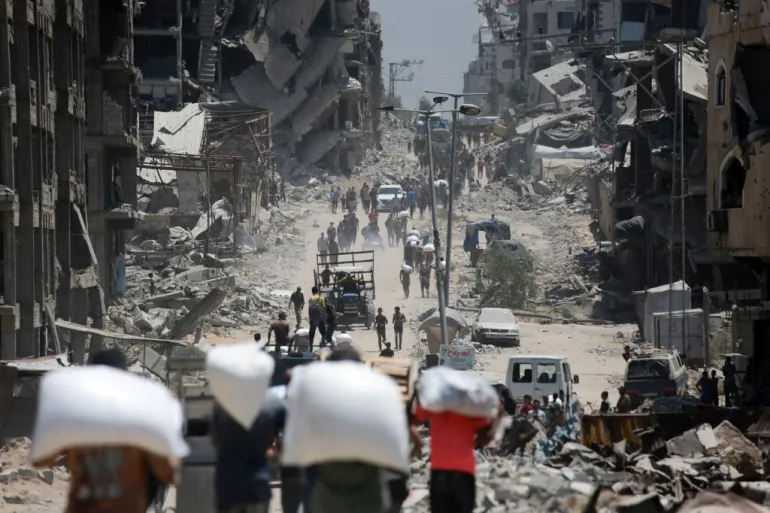
Israel appears to be “engineering controlled chaos and massacres” by obstructing the delivery of humanitarian aid in the Gaza Strip—an alarming accusation made by the international humanitarian organization Doctors Without Borders (MSF). Caroline Willemen, Gaza Project Coordinator for MSF, told Al Jazeera on Friday, “Despite some aid entering recently, food remains critically scarce. Every day, people risk their lives in desperate search of food.”
According to the Gaza Health Ministry, three more people—including two children—died from hunger and malnutrition in the last 24 hours. Since Israel’s aggression began in October 2023, a total of 162 people have died from starvation, including 92 children.
On Friday alone, more than 80 Palestinians were killed in Israeli attacks across Gaza. Medical sources said that 49 of them were killed and at least 270 others injured while attempting to collect aid.
In this dire context, Israel’s “policy of death by starvation” has sparked widespread global condemnation. On Tuesday, an international hunger monitoring agency warned that Gaza is facing the “worst-case scenario of famine.”
Although Israel has recently allowed limited airdrops of aid, senior UN officials have criticized the method as expensive, dangerous, and ineffective. They asserted that without full land access, famine in Gaza cannot be prevented.
Philippe Lazzarini, head of the United Nations Relief and Works Agency for Palestine Refugees (UNRWA), wrote on X (formerly Twitter), “If there is political will to allow airdrops, then there should be political will to open the road crossings. As people are dying of hunger, the only way to respond is to flood Gaza with assistance.”
Olga Cherevko from the UN’s Office for the Coordination of Humanitarian Affairs (OCHA) told Al Jazeera, “What is coming in is nowhere near enough. The needs on the ground are so overwhelming that even slight increases in aid make no meaningful difference.”
The situation on the ground is even more harrowing. Ordinary Palestinians are risking death near aid centers run by the Global Humanitarian Foundation (GHF), which is backed by the United States and Israel.
Ibrahim Mekki, a resident of the Nuseirat refugee camp, said, “I waited in line for six hours, risking being shot—only to receive a few packets of pasta.”
He added, “It’s a trap. They let you move a little, and then they open fire.”
According to the UN Human Rights Office, since GHF began operations in Gaza in May, at least 1,373 aid seekers have been killed. Among them, 859 died near GHF aid centers and 514 were killed along food convoy routes. In most cases, the killings were carried out by Israeli forces.
MSF’s Willemen described an incident last week at the Zikim crossing, where Israeli forces opened fire on people trying to access aid. “People were wounded by gunfire, and some were crushed as crowds panicked and fled. These incidents happen every single day,” she said.
“This distribution mechanism is creating controlled chaos and orchestrated massacres,” Willemen concluded.
Despite growing international condemnation of GHF’s operations, both the U.S. and Israel continue to support the organization. On Friday, U.S. Special Envoy for the Middle East Steve Witkoff and U.S. Ambassador to Israel Mike Huckabee visited Gaza to inspect GHF’s operations and discuss plans for food and medical aid distribution.
Last month, the Trump administration allocated $30 million to support GHF. The U.S. also continues to provide Israel with billions of dollars in annual military and diplomatic assistance—support that has only increased since the war on Gaza began.

প্লিজ লগইন পোস্টে মন্তব্য করুন!
আপনিও পছন্দ করতে পারেন

- Jul 01, 2026
Record Ocean Heat in June as Global Sea Tempe...
- Jul 01, 2026
Pakistan–Afghanistan Border Tensions Escalate...
- Jul 01, 2026
UN Seeks $100 Million to Support Palestinian...
- Jun 27, 2026