- Nov 04, 2026
Israeli Settlement Expansion and Violence Reach Record Highs in West Bank
- Sep 14, 2026
- International
International Desk | PNN
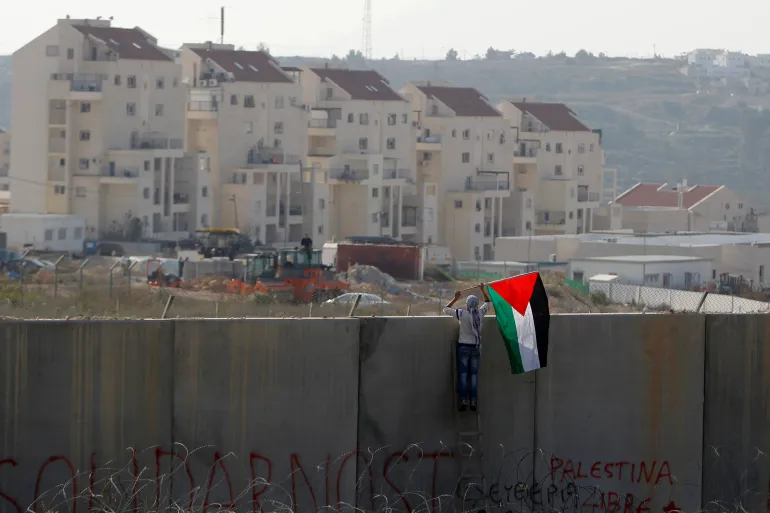
Israeli settlement expansion in the occupied West Bank and East Jerusalem, along with attacks by settlers on Palestinians, has increased at an alarming rate. Israeli settlements have long been regarded as violations of international law, but in recent years the expansion of these settlements and new outposts has accelerated further.
These settlements in the Israeli-occupied West Bank and East Jerusalem are primarily inhabited by Jewish Israelis. Although many settlements resemble ordinary residential areas, structures built on hilltops have created strategic control over surrounding Palestinian towns and villages.
According to Peace Now, an organisation monitoring Israeli settlements, there are at least 148 settlements in the occupied West Bank and another 15 in East Jerusalem. In total, around 750,000 Israelis live in the 163 settlements, accounting for nearly 10 percent of Israel’s total Jewish population.
Settlement expansion has increased significantly over the past six decades since the occupation of the West Bank and East Jerusalem in 1967. What began as isolated hilltop outposts has now developed into an extensive network of roads, highways and large residential areas.
According to 2024 estimates, 744,700 Israelis were living in these settlements. Of them, 511,100 were in the West Bank and 233,600 in East Jerusalem. In addition, the number of unauthorised outposts has exceeded 400. Many of these outposts are later connected to authorised settlements or placed under legalisation processes.
Under international law, Israeli settlements in the West Bank and East Jerusalem are illegal. Under the Fourth Geneva Convention, an occupying power is prohibited from transferring its own population into occupied territory. The United Nations Security Council, the International Court of Justice (ICJ) and the International Committee of the Red Cross, among other international organisations, have repeatedly reaffirmed this position.
In its advisory opinion issued in July 2024, the ICJ also identified various aspects of Israel’s settlement policy and occupation as inconsistent with international law.
Under Israeli law, however, many of these settlements have been established with government approval, planning and funding. Outposts, on the other hand, are generally established on a small scale without formal government approval. Later, many of them are subjected to efforts to legalise them or incorporate them into existing settlements.
Over time, several Israeli settlements have grown to the size of cities. They now have mayoral offices, educational institutions, shopping centres, medical facilities and even universities.
Among the largest settlements, Modi'in Illit has a population of 89,301. It is followed by Beitar Illit, where 70,251 people live. Pisgat Ze'ev in East Jerusalem has a population of 48,419.
A significant portion of the road network built to connect these settlements with Israel is restricted or prohibited for Palestinian movement. Many bypass roads have been constructed through Palestinian territory, obstructing local connectivity and isolating communities from one another.
One major example is the E1 area east of East Jerusalem. If plans to expand the Ma'ale Adumim settlement there are implemented, there are concerns that East Jerusalem could become even more isolated from other parts of the West Bank.
In August 2025, Israeli Finance Minister Bezalel Smotrich approved the construction of more than 3,000 new housing units under the E1 project. The decision to revive the plan, which had been suspended for decades because of international pressure, drew strong reactions from various countries and international organisations.
Around 30 governments and the European Commission described the initiative as unacceptable and a violation of international law.
Alongside settlement expansion, violence by Israeli settlers against Palestinians has also increased. According to data from the United Nations Office for the Coordination of Humanitarian Affairs (OCHA), there were 852 settler attacks in 2022 that resulted in Palestinian casualties or property damage. The number increased to 1,836 in 2025.
That means an average of nearly five attacks were recorded every day that year.
From October 7, 2023, through various periods of 2026, the number of such attacks increased further. During that period, a total of 5,131 attacks were recorded. OCHA recorded 1,418 attacks between January and July 2026 alone. As the year has not yet ended, the number could increase further.
Analysts say that although settlement expansion and settler violence are two separate trends, they are closely connected in practice. On the one hand, existing settlements are expanding through government plans and approvals, while on the other, unauthorised new outposts and local-level violence are further expanding the Israeli presence on Palestinian land.
UN officials and various experts have described some recent attacks as “pogroms.” Israeli military officials have also used the term following attacks such as the one in Huwwara.
As a result, settlement expansion, the establishment of new outposts and violence against Palestinians are collectively and rapidly changing the territorial and demographic structure of the West Bank, according to observers.

প্লিজ লগইন পোস্টে মন্তব্য করুন!
আপনিও পছন্দ করতে পারেন


- Nov 04, 2026
Republicans Suffer Major Defeat as Democrats...

- Nov 04, 2026
Democrats Win Control of Both Chambers of US...

- Nov 04, 2026
Abdul El-Sayed Set to Become First Muslim US...
- Oct 31, 2026