- Nov 04, 2026
International Freedom Flotilla Sets Sail for Gaza Again, Aims to Arrive in October
- Sep 05, 2026
- International
International Desk, PNN
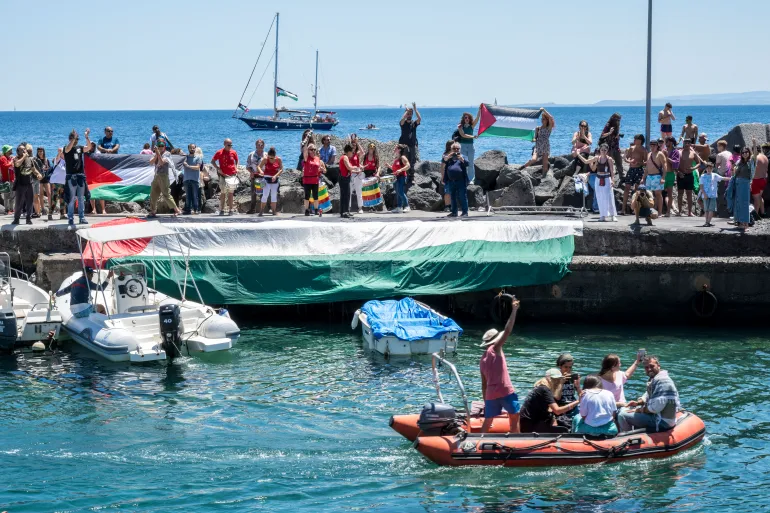
The Freedom Flotilla Coalition (FFC) has once again announced an international maritime mission against the Israeli blockade of Gaza.
Several ships organised by the coalition have already been making stops at various European ports. According to the plan, the flotilla will travel through several European countries before attempting to reach the coast of Gaza in October.
The FFC said the main objective of this latest mission is to draw international attention once again to the Israeli blockade and restrictions preventing food, water and medical supplies from entering Gaza.
Although there have been allegations of abuse by Israeli forces against volunteers and activists who participated in previous missions, the coalition has not backed away from its new mission.
The coalition claims that incidents involving beatings, repeated electric shocks and sexual abuse of activists who participated in previous missions have been documented.
Despite these risks, the organisation says there is a need to maintain international pressure over the situation in Gaza.
According to information from the FFC, two ships have already begun this year’s mission.
A ship named Handala-2 travelled through the Scandinavian region in June and July, stopping in Norway, Sweden and Denmark.
Meanwhile, another ship named Kate departed from the UK port of Bristol at the beginning of this month. It subsequently travelled to various ports in Ireland, Germany and France.
At the next stage, the ships are scheduled to stop at ports in Spain, Portugal and Italy.
After completing these port visits, the ships are expected to cross the Mediterranean Sea and proceed toward Gaza.
Johar Chamberlain Regev, a member of the FFC steering committee, said they had returned to sea because various governments were failing to properly fulfil their responsibilities regarding Gaza.
He said they would demand at every port that Palestinians be guaranteed the right to live with dignity.
Human rights activists, peace activists, elected representatives, journalists, doctors and representatives of various organisations working for Palestinian rights are participating in the new flotilla.
The Flotilla Coalition has made several demands to the governments of the countries involved.
These include ensuring the safe passage of the flotilla, putting pressure on Israel to stop obstructing the entry of food, water and medicine into Gaza, and ensuring diplomatic consequences if the ships are attacked or seized.
At the same time, the organisation has called for diplomatic and economic measures to end the blockade.
Edward DiGilio, an engineer from Maryland in the United States who is participating in the mission, said they were aware that travelling toward Gaza was risky.
However, he said the cost of remaining silent and taking no action while Palestinians were suffering was even greater.
Attempts to reach Gaza by sea are not new. Such initiatives began with the first mission of the Free Gaza Movement in 2008.
The 2010 Israeli raid on the Mavi Marmara ship, in which 10 activists were killed, has also remained a significant chapter in the history of the flotilla movement.
Over the past year, the Global Sumud Flotilla heading toward Gaza has faced Israeli military intervention several times.
The FFC said more than 450 participants were detained in October 2025. Among those detained were South African writer Zukiswa Wanner and Mandla Mandela, the grandson of Nelson Mandela.
Then, in April 2026, around 175 more people were detained.
Amnesty International said it had documented information regarding various forms of mistreatment of some detainees, including sleep deprivation and denial of water and medical care.
Two activists detained during the April mission, Thiago Avila and Saif Abukeshek, were allegedly kept without contact with their families for several days. They were later deported from Israel.
The flotilla’s new initiative comes at a time when international concern over Gaza’s humanitarian situation has not diminished even after the ceasefire.
According to UNICEF, more than 82 percent of families in Gaza are still facing a lack of safe and adequate water.
At the same time, around 90 percent of the water and sanitation infrastructure has been destroyed.
Reports of attacks on hospitals, aid warehouses and facilities storing medical supplies in Gaza have also emerged in recent weeks.
According to Gaza’s Ministry of Health, more than 1,300 people have been killed in Israeli attacks even after the ceasefire came into effect in October 2025.
In addition, many people are still missing or are believed to be trapped beneath the rubble.
Against this backdrop, the Freedom Flotilla Coalition’s new maritime mission could once again draw international attention to the blockade of Gaza and the humanitarian crisis there.
However, the major question now is whether the flotilla will face Israeli intervention again, as it did during previous missions.

প্লিজ লগইন পোস্টে মন্তব্য করুন!
আপনিও পছন্দ করতে পারেন


- Nov 04, 2026
Republicans Suffer Major Defeat as Democrats...

- Nov 04, 2026
Democrats Win Control of Both Chambers of US...
- Nov 04, 2026
Abdul El-Sayed Set to Become First Muslim US...
- Oct 31, 2026