- May 20, 2026
From Economic Growth to Global Security: The Tiny Chip That Could Become Bangladesh's Biggest Shield
- Jul 26, 2026
- Exclusive
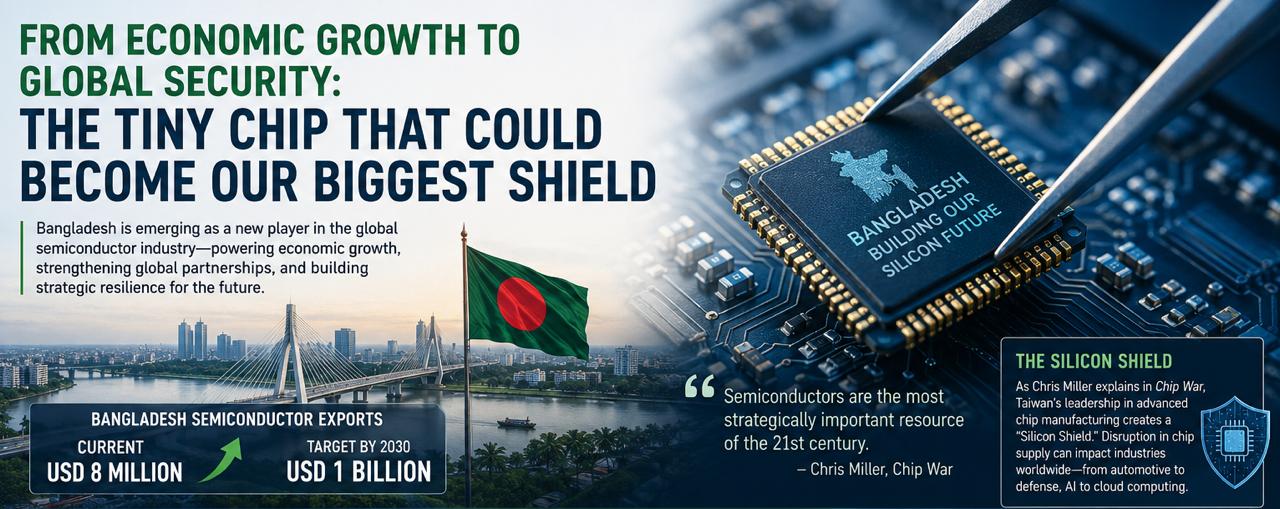
Ask most people to list Bangladesh's exports and you'll hear garments, pharmaceuticals, leather, IT services. Almost no one says semiconductors. Yet Bangladesh already exports chips to the United States, Japan, and the European Union. The volume is small. The signal is not.
The Bangladesh Investment Development Authority (BIDA) aims to grow semiconductor exports from around $8 million to $1 billion by 2030 — a moonshot set against a global market projected to cross $1 trillion by the same year. By any honest measure, it's a small bet in an enormous game. But small, early bets are how strategic industries get built.
The groundwork is already underway. In the FY2026–27 budget, Bangladesh extended customs, VAT, and tax concessions on semiconductor design software, EDA tools, and packaging machinery until 2031, giving investors the long-horizon certainty this capital-intensive sector demands. The Silicon River USA Roadshow and the two-day BEAR Summit 2026 have reinforced that message internationally: Bangladesh wants a seat at this table.
Why a chip is never just a chip:
In the book “Chip War”, Chris Miller calls semiconductors Taiwan's "silicon shield" — the idea that Taiwan's grip on advanced chip manufacturing makes it too vital to lose and too dangerous to disrupt. A serious shock there — conflict, disaster, geopolitical rupture — would ripple through cars, phones, defense systems, AI, and cloud computing worldwide. Miller's point is broader: nations that lead in chip design and manufacturing buy themselves economic leverage, technological leverage, and geopolitical leverage all at once.
That's the real prize behind Bangladesh's ambition. This isn't export diversification sitting next to jute and garments. It's an attempt to hold a stake, however small, in a resource that now shapes global power.
Where Bangladesh actually stands:
The country isn't starting from zero. By 2024, semiconductor design-services exports had reached $8 million, with nearly 700 chip designers working across the industry, and universities nationwide are expanding VLSI programs to build the next generation of talent. Cost works in Bangladesh's favor too: operating expenses in Dhaka run 16–30% below compared to two established regional hubs, 16-20% less than Bangalore (India) and roughly 30% below Cebu (Philippines),.
But the comparison sobers quickly. India has committed more than $13 billion to its semiconductor programme; Vietnam is training 50,000 design engineers by 2030. Against that, Bangladesh's ambitions are modest — and the $1 billion target will hinge less on new incentives than on how fast the country builds skilled talent, research capacity, and testing infrastructure.
That's the real gap. It's a gap of capability, not intent — and it's closable.
What it will take:
The task ahead isn't just manufacturing chips. It needs a stitching together an ecosystem: global Bangladeshi engineers and diaspora experts, domestic industry, universities, investors, and policymakers, all moving in the same direction. We must sketch the progress with — dozens of new VLSI design firms, International certified ATMP (Assembly, Testing, Marking, and Packaging), OSAT (Outsourced Semiconductor Assembly and Test), and at least one global semiconductor player willing to open a design centre here.
A small bet, seriously placed:
Bangladesh will not become the next Taiwan overnight, and no one serious should claim otherwise. But a young, growing engineering talent pool, competitive costs, a strategic geographic position, and a policy environment now actively courting this sector give the country a chance to become a meaningful node in the global semiconductor value chain.
The chip is tiny. What it represents is not. If Bangladesh treats this decade as the window it actually is, rather than a talking point, this small piece of silicon could become one of the country's most valuable strategic assets — an engine for economic growth, and a quiet form of security shield in this power world.
Author:
Khandker Shamim
He is a legal researcher on technology policy and AI governance. He is going to pursue an Advanced Master in IP & ICT Law at KU Leuven, Belgium, with a focus on Artificial Intelligence, data protection, and emerging technologies.

প্লিজ লগইন পোস্টে মন্তব্য করুন!
আপনিও পছন্দ করতে পারেন
- Apr 26, 2026
EU AI Act: A New Standard for Trust, Safety,...

- Sep 24, 2025
Violence Breaks Out During Statehood Agitatio...

- Sep 04, 2025
Refugee Women in Sudanese Camp Cry Out: ‘Mone...

- Sep 03, 2025