- Jul 06, 2026
Bangladesh’s GDP Growth Could Reach 4.8%: World Bank
- Oct 07, 2025
- Business
Staff Reporter | PNN:
The World Bank has forecast that Bangladesh’s gross domestic product (GDP) growth for the current fiscal year could reach 4.8 percent. This represents a slight improvement compared to the previous fiscal year, mainly due to reduced inflationary pressures boosting private consumption. The Bank also expects growth to rise to 6.7 percent in the 2026-27 fiscal year.
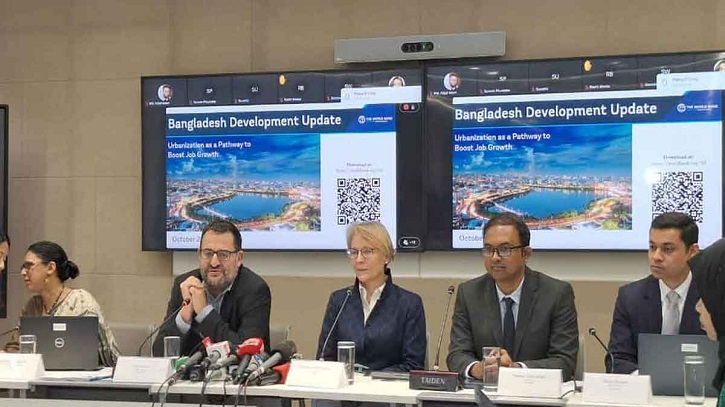
The forecast was presented on Tuesday (October 7) at the World Bank’s office in Agargaon, Dhaka, during a press conference highlighting the Bangladesh Development Update. Simultaneously, the Asia Development Update report was also released.
At the press briefing, World Bank Divisional Director Jean Pesme spoke, while the Asia Development Update was presented by Dhaka Office Chief Economist Franziska Lesloot Ohsez, and the Bangladesh Development Update was presented by the Bank’s economist Najsus Sakib Khan.
The report notes that while investment is expected to improve in the current fiscal year, political uncertainty and ongoing weaknesses in the banking sector could slow this momentum. Imports are returning to normal, suggesting only a minor deficit. With improved economic activity, revenue growth is expected to keep the fiscal deficit below 5 percent of GDP.
Although inflation has trended downward in recent months, it rose to 8.3 percent in August 2025. Food inflation, on the other hand, fell significantly from 13.8 percent in November 2024 to 7.6 percent in August 2025. Exchange rate stability and restored food supply have helped control inflation.
The report also expresses concern over rising poverty. The national poverty rate is estimated to have increased from 20.5 percent in FY2024 to 21.2 percent in FY2025.
Labor force participation declined from 60.9 percent in 2023 to 58.9 percent in 2024, primarily due to reduced female participation. During this period, nearly 3 million working-age people were out of the labor force, including 2.4 million women.
Weaknesses in the financial sector persist, especially in banking, with non-performing loans posing a major challenge. The capital-risk-weighted asset ratio has fallen to 6.3 percent, far below the minimum requirement of 10 percent. To address this, the government has taken initiatives such as merging weak banks and strengthening the legal framework for central bank governance and corporate governance.
Slow Growth and Tax-to-GDP Advice
The report projects that weak investment has led to a slight slowdown in GDP growth, with FY2025 growth estimated at 4.0 percent, compared to 4.2 percent in FY2024. This slowdown is attributed to political uncertainty, high business operating costs, and reduced implementation of development projects (ADPs).

প্লিজ লগইন পোস্টে মন্তব্য করুন!
আপনিও পছন্দ করতে পারেন


- Jul 06, 2026
Gold Price Reduced by Tk 3,266 Per Bhori, BAJ...

- Jul 06, 2026
Government Invites Investment to Revive 44 St...

- Jul 06, 2026
Government Reconstitutes Public Procurement C...
- Jul 03, 2026