- May 02, 2026
Bangladesh–Japan MoU signed on marine fisheries and the blue economy
- Jan 15, 2026
- Business
Staff Reporter | PNN
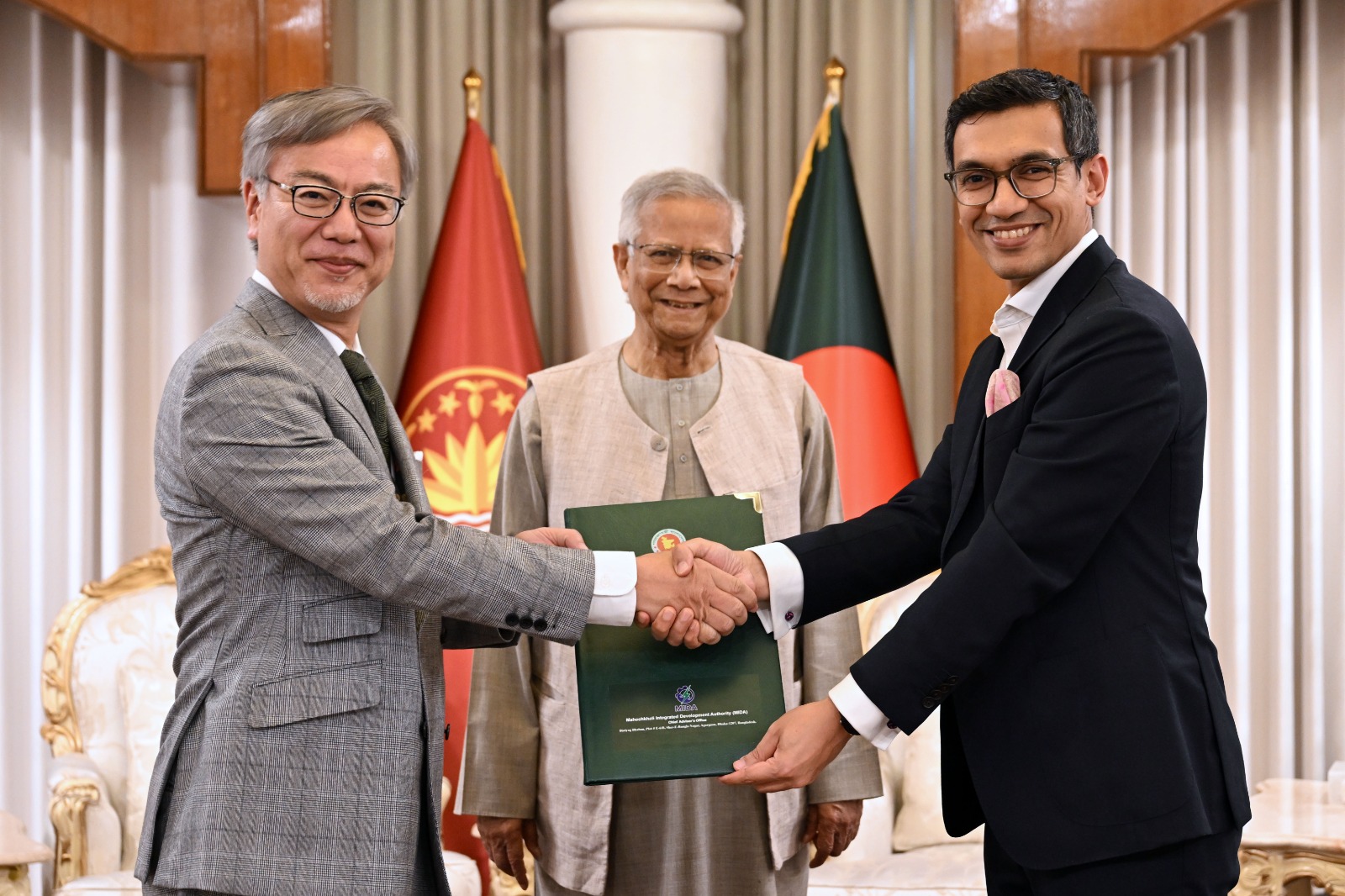
To promote ocean conservation, protect marine fisheries resources, and develop a sustainable blue economy, the Maheshkhali Integrated Development Authority (MIDA) has signed a Memorandum of Understanding (MoU) with Japan’s Sasakawa Peace Foundation (SPF).
The MoU was signed at 4:30 p.m. on Wednesday at the state guest house Jamuna by MIDA Executive Chairman Chowdhury Ashik Mahmud Bin Harun and Professor Mitsutaku Makino, President of the Ocean Policy Research Institute (OPRI) under the Sasakawa Peace Foundation. Interim government Chief Adviser Professor Muhammad Yunus was present at the ceremony. It was announced that SPF President Dr. Atsushi Sunami will formally approve the agreement in the coming weeks.
Speaking at the event, Professor Muhammad Yunus said that although the ocean is an important resource for Bangladesh, it is now facing serious threats due to pollution. He noted that plastic waste has been found even in deep-sea areas and said that through this cooperation, effective measures can be taken to keep the ocean clean and protected.
He further said that protecting marine resources is essential for Bangladesh. He mentioned the Sasakawa Peace Foundation’s international reputation in marine research and expressed satisfaction over the initiation of research collaboration. He added that the Institute of Marine Sciences at the University of Chittagong will also be involved in the research, and cooperation will expand further in the future.
Under the MoU, there are plans to develop three villages in Maheshkhali as “model fishing villages.” These villages will be developed following Japan’s “Umigyo” concept, which focuses on community-based development centered on marine industries.
As the interim government’s designated authority for coastal development and strategic infrastructure, MIDA will work through this partnership to implement national priorities in the fisheries and marine sectors. The cooperation is expected to play an important role in achieving coordinated goals involving more than 20 ministries and agencies related to policy-making in this sector.
The Sasakawa Peace Foundation, one of the world’s largest independent philanthropic organizations, has long been working on marine policy, disaster risk reduction, and inclusive development in the Indo-Pacific region.
Under the agreement, both parties will jointly conduct feasibility studies on marine aquaculture, fisheries management, post-harvest fish processing, marine food processing industries, and the welfare of fishing communities, following Japan’s blue economy model.
Emphasis will also be placed on coastal livelihood development, maritime security, community-based marine resource management, local economic development, and building effective communication systems between fishing communities and the government.
Another key aspect of the cooperation is preliminary research into fisheries resources and the potential of coastal tourism. Initiatives will also be taken to develop jetties, modern fish landing centers, cold-chain and transportation systems, marine food processing centers, and improved market management.
Under the MoU, training programs will be implemented on deep-sea fishing, fish preservation and processing, marine aquaculture, value-added product production, export diversification, investment facilitation, disaster management, maritime security, quality control, hygiene, and labor standards.

প্লিজ লগইন পোস্টে মন্তব্য করুন!
আপনিও পছন্দ করতে পারেন

- May 02, 2026
UAE leaves OPEC, new equation in global energ...

- May 02, 2026
Bangladesh Bank relaxes provisioning rules fo...
- Apr 30, 2026
Bangladesh–China meeting: discussion on stren...

- Apr 30, 2026