- May 02, 2026
Bamboo Trade in Rangamati: Potential Revenue in Hundreds of Crores, Special Industrialization Needed
- Sep 11, 2025
- Business
PNN News Desk | Rangamati:
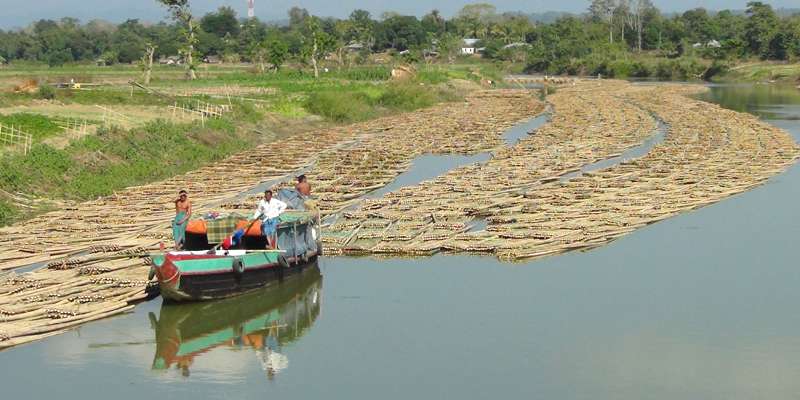
Rangamati – After timber and fish, bamboo trade has emerged as one of the largest businesses in Rangamati. Every year, bamboo trade in the region generates over hundreds of crores of Taka, from which the government also collects substantial revenue. Experts believe that with proper bamboo-based industrialization and organized export systems, this sector could become a significant source of foreign currency earnings.
Approximately 18 million bamboo poles are harvested annually from the Baghaichhari, Kawkhali, and Naniarchar Upazilas. Other areas such as Barkal, Juraichhari, Bilaichhari, Rajsthali, Rangamati Sadar, and Kaptai also contribute to bamboo production. However, due to deforestation and reduced production in protected forest areas, recent harvests have fallen below 20 million bamboo poles. Individual initiatives in bamboo plantations have slightly increased production.
According to the Rangamati Forest Department, in the 2022-23 fiscal year, nearly 13,552,457 bamboo poles were harvested from protected forests and cultivated bamboo plantations. The main species include Muli, Ora, Mitinga, Dulu, Farua, and Baijja, with Muli bamboo being the most produced. The government collects BDT 1.40 in revenue per bamboo pole.
Kutukchhari Market has developed as the central hub for the bamboo trade. Workers bring bamboo from various parts of the district to the market. Bamboo is sold depending on size and species, ranging from BDT 15 to 200 per pole. Each season, several trucks transport bamboo from Kutukchhari Market to Chattogram, Cox’s Bazar, Feni, Dhaka, and other districts, generating trade worth nearly BDT 50 million.
However, experts point out that despite playing a crucial role in fulfilling national demand for over a century and a half, no bamboo-based industry or factory has been established in the hills. Md. Ismail Hossain, Assistant Manager of Rangamati Small and Cottage Industries Corporation (BSCIC), said that with modern machinery and proper planning, bamboo could be effectively utilized to boost the local economy and establish new economic zones.
Currently, bamboo and bamboo-based products are used in handicrafts, construction materials, furniture, and various other sectors. Being an eco-friendly material, the international demand for bamboo, particularly in China and Thailand, is steadily increasing.

প্লিজ লগইন পোস্টে মন্তব্য করুন!
আপনিও পছন্দ করতে পারেন

- May 02, 2026
UAE leaves OPEC, new equation in global energ...

- May 02, 2026
Bangladesh Bank relaxes provisioning rules fo...

- Apr 30, 2026
Bangladesh–China meeting: discussion on stren...

- Apr 30, 2026