- Nov 04, 2026
Vessel traffic decreases in Hormuz, yet Iran refuses to relinquish control
- Aug 20, 2026
- International
International Desk. PNN
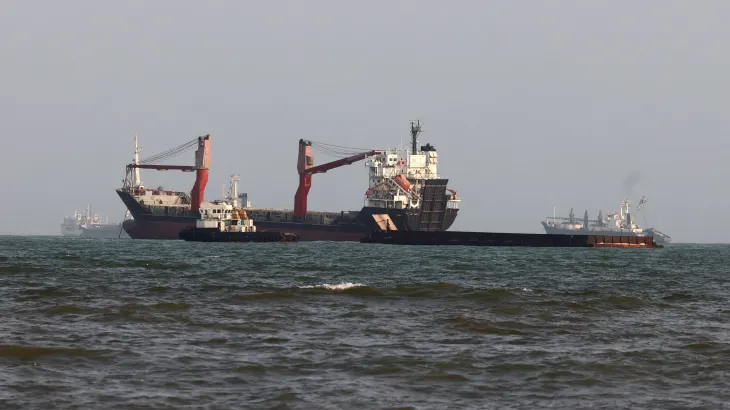
Questions have resurfaced regarding the control of the crucial Strait of Hormuz amid mutual claims, naval blockades, and military tensions involving Iran and the United States. US President Donald Trump claims that the United States maintains control over vessel navigation in the strait, even hinting at taking control of the territory in the future.
Iran, on the other hand, asserts that no ship can navigate through the Strait of Hormuz without Tehran's permission. The United States also continues to maintain a naval blockade targeting vessels affiliated with Iran.
However, an analysis of recent maritime traffic data outside of statements from both sides indicates that the practical reality is far more complex.
Prior to the onset of war, vessel transit through the Strait of Hormuz primarily adhered to the designated Traffic Separation Scheme. Factors such as port destinations, cargo transport contracts, and maritime security played the primary role in route determination.
However, the situation shifted following the escalation of the Iran-US conflict. Currently, friction centers around two main routes in the strait.
One is the northern route hugging the Iranian coastline, passing near Larak and Qeshm islands toward Iranian ports and offshore terminals. The other is the southern route close to Oman. The United States is primarily encouraging commercial vessels to utilize this Omani route, with some ships being provided naval security escort.
According to data from maritime intelligence firm Kpler, a total of 112 crude oil, LPG, and LNG tankers passed through the Strait of Hormuz between August 1 and August 19.
Among these, 21 vessels openly utilized the Iranian route. Only two ships reported using the Omani route.
The trajectories of the remaining 89 vessels were dark or unclassified—meaning many of these ships had switched off their Automatic Identification System (AIS) transponders, or their movement data did not conclusively match any specific route.
As a result, it is not possible to confirm with certainty how many of these ships used the Omani route and how many navigated via the Iranian route.
Beyond fuel-bearing tankers, a total of 236 vessels transited through Hormuz during the same period, including dry bulk carriers and chemical tankers.
According to Kpler's data, 83 vessels openly used the Iranian route. Only three ships utilized the Omani route, while two vessels used the central route that was conventional prior to the war.
The specific routes for the remaining 148 vessels could not be identified.
Thus, based on publicly available data, the number of ships using Iran's designated route is significantly higher than those using the US-backed Omani route.
In the current environment, AIS transponders serve as one of the most vital technologies for identifying ship locations. However, fearing military attacks in Hormuz, many vessels are switching them off.
According to experts, this renders vessel positions and trajectories less visible to military forces, which may marginally reduce the risk of attacks. However, it simultaneously raises concerns regarding maritime safety and transparency.
In the ongoing conflict, both Iran and the United States claim to have targeted vessels that they deemed to be in violation of their designated rules or routes.
On August 8, the United Arab Emirates accused Iran of launching a missile attack on an Abu Dhabi National Oil Company (ADNOC) tanker. ADNOC stated that 15 of its vessels have been targeted by missile and drone attacks while transiting Hormuz since the outbreak of war.
Conversely, on August 11, the United States announced that two Hellfire missiles were fired from a US Navy helicopter at a Panama-flagged cargo vessel attempting to break its naval blockade against Iran.
Another reason for concealing ship locations could be ship-to-ship (STS) cargo transfers in mid-ocean. According to experts, some nations and companies are attempting to transport goods through this method to directly evade surveillance.
In certain instances, a ship proceeds along the Omani route with its transponder turned off, later offloading cargo onto another vessel outside the strait to be sent onward to its destination.
Experts report similar tactics being employed by Iranian vessels. It is also alleged that paperwork for certain goods is being altered to route them through Oman to reach the market in order to evade sanctions and the US blockade.
From current data, it remains difficult to reach a definitive conclusion regarding who holds absolute control over the Strait of Hormuz, as a vast number of vessels conceal their movements.
However, one aspect is evident: despite the presence of the US Navy and its blockade, a significant number of ships continue to openly navigate through Iran's designated route.
Considering oil and gas tankers alone, nearly one-fifth of the vessels utilized the Iranian route. When accounting for all types of ships, the proportion of those openly using the Iranian route is even higher.
On the other hand, the number of ships openly transiting outside Iran's designated route remains exceptionally low.
According to analysts, this at least indicates that under current conditions, a large portion of vessel operators are prioritizing Iran's potential military reaction over US threats when making navigation decisions.
Experts assess that Iran still retains substantial capability to disrupt maritime traffic in Hormuz. However, that control is neither sole nor absolute.
Alternative routes, ship-to-ship cargo transfers, covert transit, and regional security measures may gradually constrain Iran's ability to exert pressure.
Nevertheless, as war and tensions escalate, the global energy market is feeling the brunt.
Prior to the outbreak of conflict involving the US, Israel, and Iran, approximately one-fifth of the world's oil and LNG passed through the Strait of Hormuz. Before the war, roughly 130 ships transited the waterway daily.
In contrast, only 236 vessels passed through the strait during the first 19 days of August—representing a significant drop in traffic compared to normal times.
This has impacted oil prices. Before the conflict began, Brent crude was trading at around $66 per barrel in the international market. During the war, it crossed $100 on multiple occasions, climbing as high as $119 in March.
On Thursday morning, Brent crude was priced at approximately $92.90 per barrel.
According to analysts, if the impression takes hold that Iran's influence in Hormuz is diminishing, Tehran could lose one of its key strategic leverage points in negotiations. However, current maritime traffic data indicates that Iran's influence over the Strait of Hormuz remains formidable; despite its military presence, Washington has yet to establish full control over this vital waterway.

প্লিজ লগইন পোস্টে মন্তব্য করুন!
আপনিও পছন্দ করতে পারেন


- Nov 04, 2026
Republicans Suffer Major Defeat as Democrats...
- Nov 04, 2026
Democrats Win Control of Both Chambers of US...

- Nov 04, 2026
Abdul El-Sayed Set to Become First Muslim US...
- Oct 31, 2026