- Nov 04, 2026
Uncertain Lives and Fear of Attacks: Residents of Yemen’s Mocha Face Crisis
- Oct 04, 2026
- International
International Desk | PNN
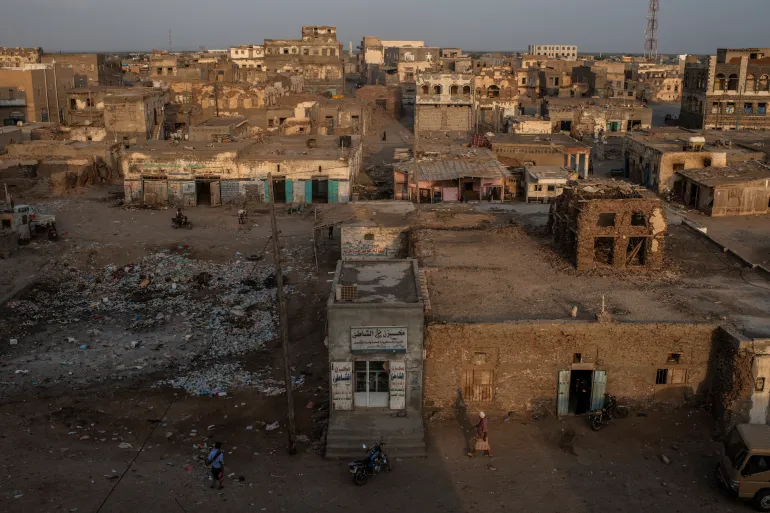
Thousands of civilians remain trapped in and around the Red Sea coastal city of Mocha in Yemen even after Houthi forces established control over the city. Alongside the fear of conflict, financial hardship is making it difficult for them to move to safer locations. As a result, many families are being forced to remain in their homes despite the risk of attacks.
Nabil, a day labourer from the village of Yakhtul north of Mocha, saw from his home early on September 10 that many people were leaving the city in fear. A few hours later, Houthi forces entered Mocha. However, Nabil and his relatives stayed behind.
According to Nabil, becoming displaced and seeking shelter somewhere else would mean living an uncertain and undignified life. He said he is not affiliated with either side and has committed no crime, which is why he decided to remain in his own home.
The Houthis’ influence in Yemen is not new. Since September 2014, the group has controlled the capital Sanaa and large parts of northern Yemen. The Saudi-led military coalition has also become involved in the conflict between Yemen’s internationally recognized government and the Houthis, which has continued for more than a decade.
According to the 2004 census, around 62,500 people lived in Mocha. However, there is currently no reliable estimate of how many people remain in the city following the recent conflict.
Pro-government forces have declared Mocha and surrounding areas a military zone. Government authorities allege that the Houthis are pressuring local residents to join the fighting or provide support.
However, several residents who spoke to Al Jazeera said they had not witnessed incidents of people being forcibly taken to rallies. One resident, who did not wish to reveal their identity, claimed that the Houthis had provided weapons to three of his neighbors and that they were now fighting against government forces.
The resident further claimed that an armed pickup truck regularly went to a particular family’s home and pressured its sons to join the Houthis. When the family refused, the vehicle eventually left.
After pro-government forces took control of Mocha in 2017, the city became a refuge for many people who had fled Houthi-controlled areas. But the situation changed when fresh fighting spread along the coastal area at the beginning of September. Many families were once again forced to leave their homes and head toward Aden, Taiz and Lahij.
On the evening of September 10, the government declared Mocha and surrounding areas a “kill box,” or a war zone at high risk of attack. Attacks began there from the following day.
According to local residents, the routes out of the city are still not completely safe. Although the government announced that it had opened the old Al-Barh road, not everyone was able to leave through that route. Some managed to escape, while others faced obstacles. Again, because of a lack of money and the uncertainty of life as displaced people, many decided to remain at home.
The cost of living in Mocha is rising alongside the conflict. A curfew is in effect at night. Electricity supplies have also become irregular.
Nabil said the price of a cylinder of cooking gas has risen to around 20,000 Yemeni rials, more than double its previous price. The price of a 50-kilogram sack of flour has also increased by around 8,000 rials.
The situation is even more difficult for day labourer Nabil. In his words, it has now become difficult to cover even the cost of fuel and lunch with a single day’s income. Meanwhile, many children have stopped attending school.
Mansour, a teacher at a government secondary school, said fears of shelling and the possibility of young people being sent to fight have kept students away from school. The teacher, who lives with a family of seven, is also unable to leave Mocha because of financial difficulties.
The situation is similar for Umm Khaled, who is more than 60 years old. Her husband is physically disabled and bedridden. As a result, her biggest concern is where she can find shelter for her family.
Her son, the family’s main breadwinner, used to earn a living by fishing and had joined the pro-government National Resistance Forces. After Houthi forces advanced, he fled with his family but had to leave his wife and two children with his mother.
Hassan, a fisherman responsible for a nine-member family, also cannot afford to leave for Taiz. His question is simple: when it is already difficult to secure food for his family every day, how can he afford the cost of leaving the city?
Civilian casualties have also been reported amid the conflict. According to a local journalist, six members of the same family were killed in a bombing at a house in Mocha before dawn on September 22.
Houthi-controlled media blamed Saudi airstrikes for the attack. Saudi Arabia, however, has made no public comment on the incident.
Pro-government military officials claim that the main target of the “kill box” declaration is Houthi fighters, not ordinary civilians. However, Sultan Mahmoud, a government-appointed official in Mocha district, said that in reality it has not been possible to ensure a safe route for civilians to leave.
The conflict has also affected Mocha’s healthcare system. When Houthi forces entered the city, the international medical organization Médecins Sans Frontières (MSF) said that almost all health facilities except Mocha General Hospital had effectively closed. The crisis was caused by a large portion of healthcare workers leaving the area. At the time, around 30 healthcare workers were still on duty.
Local residents say the situation has deteriorated further since then. Doctors working with funding from various organizations have stopped working after their salaries were suspended. Some residents claim that security measures at hospitals have been strengthened and that some medical equipment has been moved to the city of Sanaa.
Humanitarian assistance is also insufficient compared with the scale of need. Officials working to assist displaced people in Yemen said that because of a lack of funds, it has become difficult to deliver relief to those who could not afford to leave the city. The pro-government side has also accused the Houthis of obstructing humanitarian assistance operations.
Overall, the people of Mocha are now facing a difficult reality. On one side is the risk of war and attacks; on the other, many do not have the money to flee their homes. Leaving also carries the risk of losing their property.
For many people like Nabil, therefore, remaining in their own homes appears to be a more realistic option than seeking a safe shelter elsewhere. If the conflict continues, there are fears that the uncertainty and humanitarian crisis facing the people of Mocha will deepen further.

প্লিজ লগইন পোস্টে মন্তব্য করুন!
আপনিও পছন্দ করতে পারেন


- Nov 04, 2026
Republicans Suffer Major Defeat as Democrats...

- Nov 04, 2026
Democrats Win Control of Both Chambers of US...

- Nov 04, 2026
Abdul El-Sayed Set to Become First Muslim US...

- Oct 31, 2026