- Nov 04, 2026
Severe gas crisis disrupts production in Ashulia factories, raising fears of losses and layoffs
- Aug 20, 2026
- Business
PNN News Desk. Dhaka
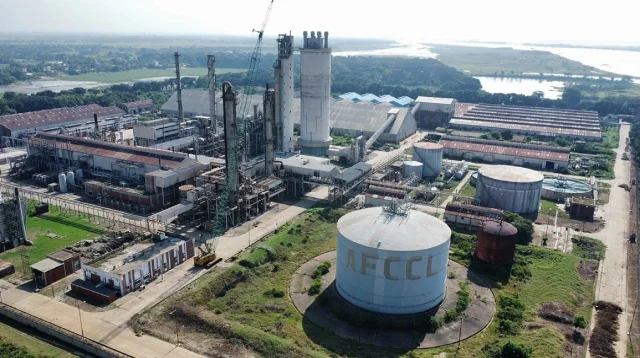
Production activities at gas-dependent factories in the industrial hub of Ashulia are being severely disrupted due to an acute gas crisis. Production capacity has dropped by up to 75 percent in some facilities, while operations have remained completely shut down for several consecutive days in others. As a result, industrial enterprises are incurring losses running into millions of Taka every day.
Even by utilizing alternative fuels to keep factories operational, many entrepreneurs are struggling to manage the situation, causing production costs to escalate. Several factory owners and officials have expressed apprehension that if this condition persists, they may be forced to make tough decisions, such as laying off workers or downsizing personnel.
At A R & O Wet Processing Limited, a concern of the Fashion Globe Group located in the Kathgara Amtala area of Ashulia, operations came to a complete halt on Wednesday night after running at reduced capacity for several weeks. Upon visiting the factory on Thursday, none of its three sections were operational. Workers were absent; only security personnel and a few officials were present on site.
Factory authorities stated that after the gas crisis began, their production gradually declined. At one point, output dropped by nearly 75 percent of standard capacity. Despite having a daily production capacity of 50,000 pieces, they could only produce up to a maximum of 20,000 pieces by sourcing gas externally.
The factory's dry process, washing, and finishing quality sections house approximately 80 to 90 machines. Due to low gas pressure, 24 of these machines have had to be kept shut down. On Thursday, the gas meter at the factory registered a pressure reading of just 2.5 PSI.
According to officials, maintaining normal production requires a gas pressure of at least 10 PSI. Yet, the pressure there frequently drops to zero or peaks at a maximum of 2.5 PSI. Furthermore, the quality of the gas is not consistently suitable for operational use.
RAK Liton, Company Secretary of Fashion Globe Group, stated that production in the washing plant has plummeted by up to 75 percent. Attempts to maintain output by bringing in gas externally using a system similar to CNG stations have failed to solve the problem. Instead, it is incurring an additional expense of nearly BDT 30,000 per hour. He added that gas pressure remains at zero for almost half the day.
Another industrial entity in Ashulia, Pakiza Group, faces a similar plight. Speaking on condition of anonymity, an official from the organization stated that their textile factory has been shut down for 15 consecutive days due to the lack of gas, causing daily losses of nearly BDT 10 million. Security guards at the factory confirmed that no workers are currently active there.
Meanwhile, at Ring Shine Textiles Limited, the dyeing unit remains open on paper, but production is virtually at a standstill, according to its Managing Director, Aniruddha Piyal. He claimed that due to the lack of gas pressure, workers sit idle at the workplace while the company incurs daily losses of approximately BDT 110 million.
Although the factory has a daily production capacity of 90 tons, it is currently unable to produce even two tons. Aniruddha Piyal explained that whenever slight gas pressure is received, machines are turned on, but before they can heat up, the pressure drops again. As a result, large batches of goods currently in process run the risk of being ruined.
Ring Shine Textiles must regularly disburse salaries and allowances to nearly 975 workers. Consequently, even with production halted, financial pressure on the enterprise continues to mount.
The gas crisis has also impacted Little Star Spinning Mills in the Jamgadh area of Ashulia. The organization's Chairman, Khorshed Alam, stated that it is currently impossible to run production using gas. Approximately 25 percent of production is being maintained using grid electricity, alongside efforts to bridge the deficit through solar power and batteries.
He noted that relying on alternative fuels has driven up production costs by nearly 12 percent, adding an extra BDT 14 to 15 per pound of yarn produced. Although gas pressure occasionally rises up to 1 to 1.5 PSI, it remains insufficient even to run generators.
Currently, production is being rationed across three shifts while keeping only two out of six sections functional. Khorshed Alam expressed concern that if the crisis persists, a decision to cut workforce by at least 30 percent may become necessary.
However, Industrial Police stated they have no records of major factory closures due to the gas crisis in the industrial belt. Superintendent of Industrial Police-1, Mohammad Mominul Islam Bhuiyan, stated that they have no information regarding any factory shutting down permanently in the Ashulia region due to the gas shortage.
He mentioned that Monno Ceramics was closed for one or two days. Additionally, Preeti Apparel and one other factory encountered similar issues during the same timeframe. However, once gas pressure normalized, production resumed in those facilities.
Although subtle discrepancies exist between statements from factory owners and data from the Industrial Police, the suffering caused by gas pressure fluctuations in Ashulia's factories remains evident. Entrepreneurs fear that unless the situation improves rapidly, disrupted production will exert heavy pressure on exports, employment, and the financial viability of industrial enterprises.

প্লিজ লগইন পোস্টে মন্তব্য করুন!
আপনিও পছন্দ করতে পারেন
- Nov 04, 2026
LPG Prices in Bangladesh Higher Than in Neigh...

- Oct 31, 2026
Gold Prices Reduced by Tk 1,633 per Bhori in...

- Oct 31, 2026
Higher Salaries Under New Pay Structure to Be...

- Oct 25, 2026