- Nov 04, 2026
Saudi Arabia, Turkey and Pakistan sign defence pact, signalling new alliance in Middle East
- Aug 08, 2026
- International
International Desk. PNN
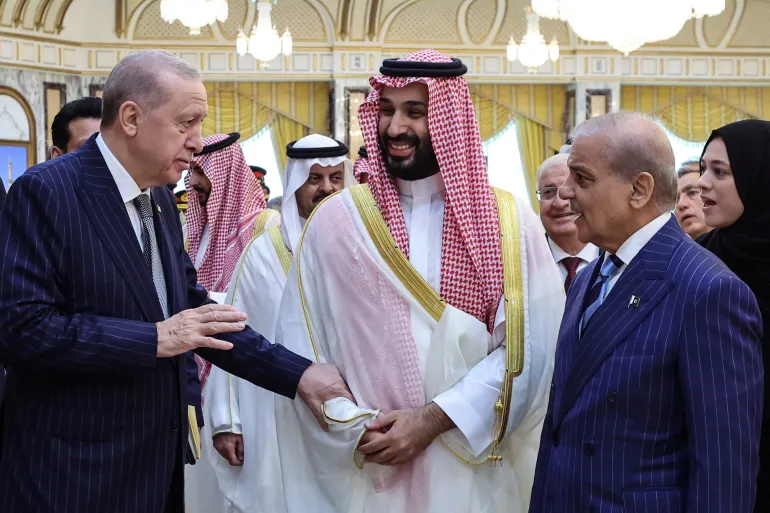
Signalling a new geopolitical equation in the rapidly changing Middle East, Saudi Arabia, Turkey and Pakistan have signed a mutual defence pact. The agreement, known as the “Mecca Joint Defence Pact,” was signed on Friday and is being viewed as a significant step in security cooperation among the three countries.
According to analysts, if the pact becomes fully operational, it could lead to the emergence of a new regional power bloc outside the Iran- and Israel-centred power structures in the Middle East. However, it remains unclear exactly what type of military response the other two countries would provide if one member came under attack.
Before the agreement, Saudi Arabia and Pakistan had already established a foundation for military cooperation. The inclusion of Turkey in the new understanding creates an opportunity for the three countries to coordinate their defence capabilities and strategic positions.
All three countries have faced different security challenges in recent years. Pakistan has experienced border tensions with Afghanistan and has also been involved in military conflicts with India in the past. Saudi Arabia has faced attacks from Iran and various Iran-backed groups. Turkey, meanwhile, has long fought Kurdish armed groups and has also seen growing tensions in its relationship with Israel.
Through the agreement, the three countries are therefore attempting to coordinate their military capabilities and establish a joint deterrence mechanism to address potential threats.
However, experts say the biggest test for the agreement will come during an actual conflict. If Yemen’s Houthis attack Saudi Arabia, for example, there is no clear answer yet as to how deeply Turkey or Pakistan would become militarily involved.
Defence analysts say the military capabilities of the three countries could complement one another under the pact.
Pakistan brings extensive military experience, arms production capabilities and nuclear power. Turkey, as an important NATO member, has a strong position in advanced defence technology, particularly in the production of drones and military equipment. Saudi Arabia, meanwhile, possesses enormous financial resources that could provide the economic foundation for large-scale defence cooperation.
As a result, experts believe that the combination of military strength, technology and financial capacity could allow the three countries to develop an effective deterrence mechanism.
The United States has long played an important role in the Middle East’s security architecture. The security framework of countries such as Saudi Arabia has also depended heavily on relations with Washington.
However, in recent years, uncertainty over US foreign policy and concerns among regional countries about Washington’s tendency to prioritise Israel in the Middle East have grown. As a result, many countries have begun to see the need to develop alternative partnerships for their security.
According to analysts, the new defence pact between Saudi Arabia, Turkey and Pakistan is part of this broader trend—an effort to increase security cooperation among themselves rather than relying on a single global power.
The pact does not directly identify any country as a target. However, given the current realities of the Middle East, the relationships of the three countries with Israel and Iran have naturally become part of the discussion.
For Saudi Arabia, Iran remains one of its major security concerns. Turkey’s relationship with Israel has also become increasingly strained in recent times. Pakistan, meanwhile, is reconsidering its strategic position in relation to conflicts in the Middle East.
Some analysts believe these circumstances have pushed the Sunni-majority countries of Saudi Arabia, Turkey and Pakistan toward closer cooperation. However, none of the three countries has so far presented the agreement as an anti-Israel or anti-Iran alliance.
There has also been discussion over whether countries such as Egypt, Qatar, Syria or the United Arab Emirates could join the new defence framework in the future. However, expanding the alliance in practice will not be easy.
Each of these countries has its own political and economic interests. Syria is currently focused on post-war reconstruction. Egypt is prioritising domestic economic stability. The United Arab Emirates has also taken positions different from those of Saudi Arabia and Turkey on various issues, including Yemen and relations with Israel.
Therefore, even if new members join in the future, the major question will be how compatible their interests and security priorities are with the objectives of the existing alliance.
According to analysts, while a defence pact may be highly significant on paper, its real strength will depend on what the other two countries actually decide if one member comes under military attack.
Middle Eastern alliances and political equations have changed many times in the past. Therefore, although discussions about the emergence of a new regional power have already begun following Friday’s agreement, its durability and effectiveness cannot yet be determined with certainty.
One thing, however, is clear: countries in the Middle East are attempting to restructure their security and defence arrangements. The agreement between Saudi Arabia, Turkey and Pakistan is an important indication of this changing regional reality.
Source: Al Jazeera

Please Login to comment in the post!
you may also like


- Nov 04, 2026
Republicans Suffer Major Defeat as Democrats...

- Nov 04, 2026
Democrats Win Control of Both Chambers of US...

- Nov 04, 2026
Abdul El-Sayed Set to Become First Muslim US...
- Oct 31, 2026