- Nov 04, 2026
Only 1 percent of VCs are genuinely helpful: Travis Kalanick
- Aug 20, 2026
- Technology
Staff Report: PNN
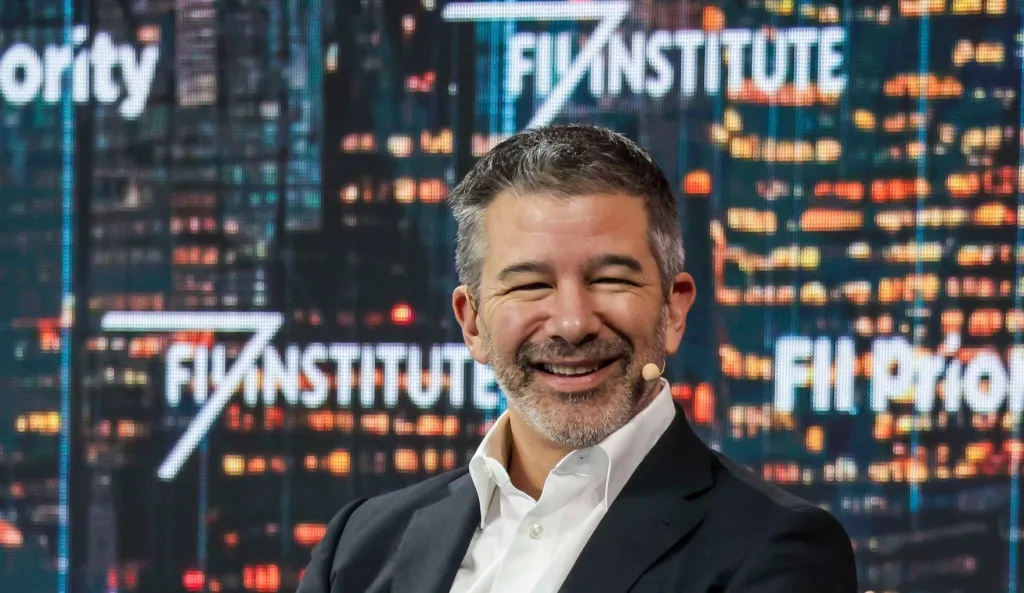
The relationship between Uber co-founder and former CEO Travis Kalanick and venture capital (VC) investors has always been complex. Investors who once viewed him as one of Silicon Valley's favorite entrepreneurs later found themselves locked in intense boardroom battles with him. Now, bringing that past experience to the forefront, Kalanick has commented candidly on the role of VCs.
In a recent interview on David Senra's podcast, Kalanick stated that the vast majority of VCs in the world are not in a position to bring about significant positive change to a startup. In his view, the minimum expectation from a VC should be to "do no harm." However, in his experience, only about 10 percent of VCs meet this baseline. Furthermore, the number of VCs who are genuinely helpful is even smaller—roughly 1 percent.
To illustrate the dynamics between a VC and an entrepreneur, Kalanick offered a chess analogy. In his words, the founder of a company is the "chess master" who manages the entire game. A VC, on the other hand, is more like a "chess enthusiast" who occasionally drops by to observe the progress of the match.
According to Kalanick, this is precisely where complications arise. An investor desires to exert influence over the company, but if the founder declines their advice, it becomes difficult for many VCs to accept. Because investors hold board seats and specific powers, they may perceive their own role as far more critical than it is.
However, Kalanick did not advise entrepreneurs to avoid VCs entirely. Instead, he recommended that founders prepare their fundraising efforts in a manner that creates competition among multiple investors to put money into their company. In his view, maintaining balance is also vital when presenting future plans to investors in today's rapidly changing AI market.
Providing too little information may cause investors to lose interest. Conversely, presenting overly detailed plans can also be problematic. Because the AI sector is evolving so rapidly, attempting to predict outcomes years in advance with extreme accuracy may instead reveal an entrepreneur's naivety.
Kalanick's skepticism regarding VCs did not stem from recent experiences, however. During his tenure as Uber’s chief executive, he raised massive amounts of capital from investors, securing nearly $15 billion in venture funding for the company.
Yet in 2017, Kalanick became embroiled in a fierce conflict with investor Bill Gurley on Uber's board of directors, which ultimately forced him to resign from the CEO position. Even after that event, his resentment toward the venture firm Benchmark has not fully faded. On the podcast, he warned entrepreneurs to exercise caution before accepting investments from Benchmark.
However, his stance does not appear to have significantly impacted Benchmark’s business operations. In June of this year, the firm raised a total of $2 billion across two new funds.
Reflecting on the boardroom conflicts at Uber, Kalanick did not place blame solely on the investors. Instead, one of his key pieces of advice for entrepreneurs is to avoid viewing oneself as a perpetual victim of circumstances.
Kalanick stated that whenever a crisis arises, an entrepreneur must examine their own role in it. According to him, developing a "victim mentality" makes it difficult to identify one's own mistakes.
In his own case, he admitted that he needed to be more adept at managing relationships with disgruntled individuals. At the same time, he noted that he now understands how his management style contributed to the problems.
Kalanick still maintains that the operational decisions he made at Uber were correct, asserting that he broke no rules. However, the "optics" of his actions—how they appeared from the outside—created significant issues.
He remarked that when leading a large and prominent enterprise, both expectations and scrutiny are exceptionally high. Even if a decision is legally sound, leaning too close to the boundary of excessive risk is unwise for the head of a company—a lesson he did not fully grasp at the time.
According to Kalanick, behind his intense and aggressive management style lay his experience with his previous startup, Red Swoosh. During the first four years of building that company, he took no salary and faced situations where the company ran out of money on multiple occasions.
That difficult period taught him to manage businesses with extreme precision and toughness. However, when Uber grew into an enterprise valued at nearly $70 billion, he retained that same survival mindset.
Kalanick realized that the level of intensity required for an entrepreneur to survive in his previous startup is not always effective for a massive organization like Uber.
Meanwhile, amidst Kalanick's comments on conflicts between entrepreneurs and VCs, another serial entrepreneur, Mark Pincus, brought forward similar past experiences. Taking to social media, Pincus highlighted his past disputes with Accel surrounding his company Support.com.
On the other hand, Kalanick's new robotics venture, Atomic, recently raised $1.7 billion in a funding round led by Andreessen Horowitz. Ben Horowitz, co-founder of the firm, has also joined Atomic's board of directors.
As a result, Kalanick—who once faced bitter experiences with venture investors—is now building a new company backed by substantial VC funding once again. His recent observations therefore reflect not just past grievances, but also the practical experience of how to foster more effective relationships between entrepreneurs and investors.

প্লিজ লগইন পোস্টে মন্তব্য করুন!
আপনিও পছন্দ করতে পারেন

- Nov 04, 2026
Retired Aircraft Jet Engines Repurposed to Ge...

- Oct 31, 2026
Password Embedded in App Code Put Applebee’s...

- Oct 31, 2026
Nvidia May Guarantee Loans for Anthropic Data...

- Oct 25, 2026