- Jun 30, 2025
Myanmar's Civil Conflict and Military Rule: Growing Concerns Over Bangladesh’s Security
- Jul 04, 2025
- Opinion & Editorial
By Special Correspondent । Arafath Habib
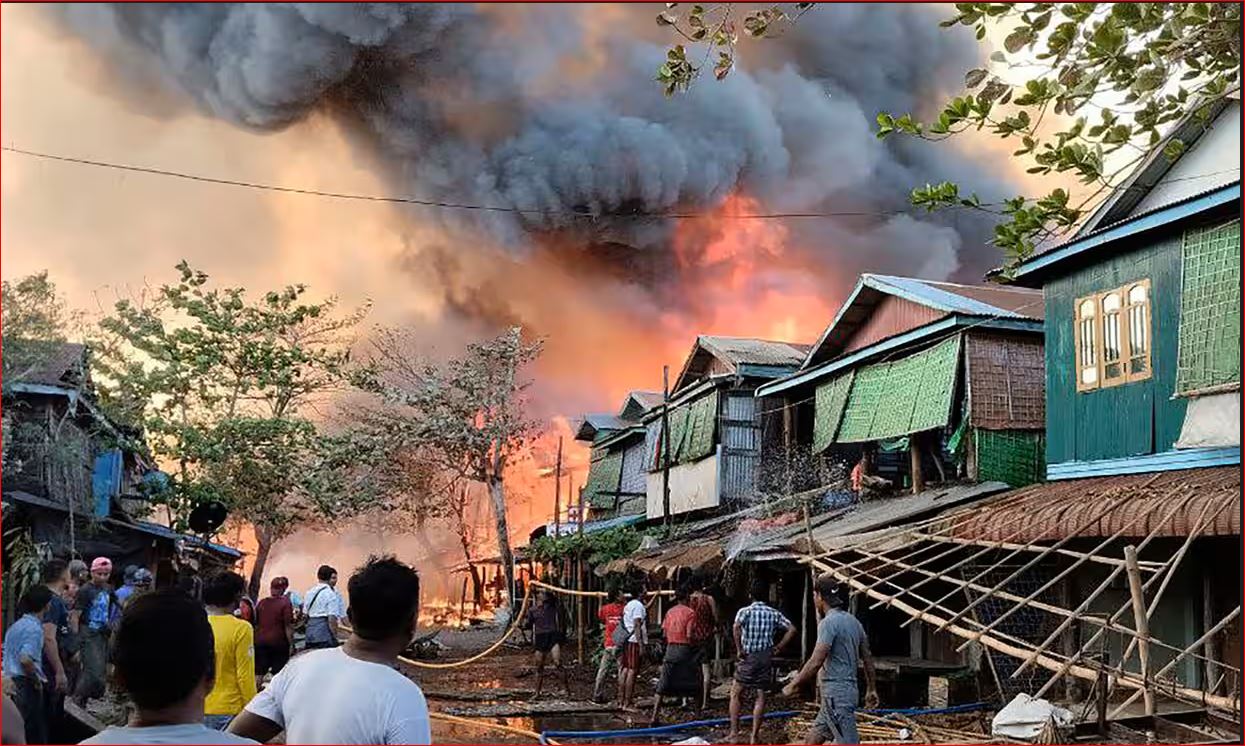
Yangon/Dhaka — On February 1, 2021, Myanmar’s fragile experiment with democracy came to a violent halt as General Min Aung Hlaing staged a military coup, detaining elected leader Aung San Suu Kyi and members of the National League for Democracy (NLD). Since then, the Southeast Asian nation has plunged into a devastating internal conflict that has not only fragmented its socio-political structure but also sent regional shockwaves—especially across the border into Bangladesh.
The Coup That Sparked a Nationwide Uprising
The Tatmadaw’s (Myanmar military) seizure of power was met with immediate and unprecedented public backlash. What began as peaceful civil disobedience quickly escalated into an armed resistance. The junta’s violent crackdowns, which have resulted in the deaths of more than 4,000 civilians according to rights groups, galvanized a generation of youth and ethnic minorities into forming a unified front under the shadow government, the National Unity Government (NUG).
Emergence of the National Unity Government and Parallel Resistance
Formed in April 2021, the NUG comprises ousted lawmakers, ethnic leaders, and activists who aim to establish a federal democracy. It functions as a parallel government, challenging the military regime’s legitimacy both domestically and on the international stage. Its armed wing, the People’s Defense Force (PDF), has grown rapidly, organizing guerrilla attacks across multiple regions.
The NUG, though not formally recognized by the UN or ASEAN, enjoys significant grassroots and diaspora support. Through alliances with ethnic armed organizations (EAOs), the NUG has become a central node in Myanmar's sprawling anti-junta movement.
Rise of Ethnic Armed Groups: Arakan Army and Beyond
Several ethnic armed groups have gained new prominence. Among them, the Arakan Army (AA) in Rakhine State has intensified its campaigns against junta forces, capturing key outposts and asserting de facto control over significant territories. The Kachin Independence Army (KIA), Chin National Front (CNF), and Karen National Union (KNU) have also coordinated offensives, eroding the Tatmadaw’s long-standing dominance in remote regions.
These groups, previously operating independently, are now loosely aligned with the NUG, forming a fragmented but potent resistance. Reports suggest over 60% of Myanmar’s townships now experience active armed conflict or resistance governance.
Humanitarian Catastrophe Unfolds
The conflict has led to a massive humanitarian disaster. Over 3 million people are displaced within Myanmar, with nearly 20 million requiring aid, according to UN OCHA estimates. Airstrikes on civilian areas, village burnings, and targeted executions have turned regions like Sagaing, Magway, and Chin State into humanitarian black holes.
Basic services have collapsed. Schools are shuttered, healthcare is skeletal, and access to food and clean water is perilously low. Aid agencies face restrictions, while the junta uses starvation as a weapon of war.
International Response: Sanctions and Stalemate
Despite international condemnation, tangible results remain elusive. The United States, United Kingdom, Canada, and the European Union have imposed targeted sanctions on top generals, arms suppliers, and junta-linked businesses. Yet, Myanmar's military continues to procure weapons from countries like Russia and China.
ASEAN’s Five-Point Consensus has failed to gain traction. The bloc’s special envoy system has been largely symbolic, with the junta stonewalling diplomacy. Meanwhile, the UN Security Council remains paralyzed by veto politics.
Rohingya Crisis: Bangladesh Bears the Burden
As Myanmar spirals further into conflict, the longstanding Rohingya refugee crisis—already one of the world's largest—grows more complex. Bangladesh currently hosts over 1.2 million Rohingya, most of whom fled a brutal military crackdown in 2021 described by the UN as “a textbook example of ethnic cleansing.”
Efforts at repatriation remain stalled due to safety concerns, the lack of citizenship rights, and escalating violence in Rakhine State. Two pilot repatriation attempts have failed, with most refugees refusing to return under current conditions.
In recent months, an additional 20,000–30,000 Rohingya have attempted to cross the border into Bangladesh amid renewed fighting between the Arakan Army and junta forces. This influx poses significant security, economic, and social challenges for Bangladesh.
Security and Criminal Risks for Bangladesh
The protracted presence of a stateless, disenfranchised population has created a fragile situation in the Cox’s Bazar region. Bangladeshi authorities report increasing involvement of Rohingya youth in drug trafficking, arms smuggling, and organized crime. The yaba (methamphetamine) trade, in particular, has surged, with Cox’s Bazar becoming a transit hub for narcotics from Myanmar.
Militant groups such as the Arakan Rohingya Salvation Army (ARSA) have also been implicated in violent clashes within the camps, targeted killings, and extortion rackets. Bangladeshi security forces have intensified surveillance, yet the threat remains deeply rooted due to poor camp conditions, unemployment, and the absence of long-term resettlement plans.
Regional Stability at Risk
The longer the crisis festers, the more regional stability erodes. Bangladesh faces a double jeopardy—managing the economic strain of hosting over a million refugees while safeguarding national security. There are also concerns over radicalization, as hopelessness and marginalization grow among camp residents.
China’s interests in Myanmar’s infrastructure corridors, India’s security calculus in the Northeast, and ASEAN’s diplomatic inertia all intersect here. Yet, there is no coherent multilateral roadmap to address the overlapping crises of governance collapse in Myanmar and refugee strain in Bangladesh.
The Road Ahead: International Intervention or Prolonged Instability
The Myanmar crisis has evolved far beyond a domestic political conflict—it is now a regional emergency. With the junta losing grip on large swaths of territory and resistance forces becoming more emboldened, the prospect of a negotiated solution seems distant.
For Bangladesh, the crisis is no longer a humanitarian challenge alone—it is a matter of national security. Without international coordination, targeted support for Bangladesh, and meaningful pressure on Naypyidaw, the region risks a prolonged period of instability.

প্লিজ লগইন পোস্টে মন্তব্য করুন!
আপনিও পছন্দ করতে পারেন
- Jun 23, 2025
Brutality Against Nature in the Name of Cox’s...

- Jun 12, 2025