- Jul 04, 2025
To Curb Crime, We Need a Strong State System over Political Parties
- Jun 12, 2025
- Opinion & Editorial
The responsibility of controlling serious social illnesses like crime, extortion, and terrorism in Bangladesh does not lie with any political party. It is a constitutional duty entrusted to the state’s law enforcement agencies and judiciary. However, it is an unfortunate reality that political identity often becomes the biggest shield for criminals. As a result, far from being brought to justice, these criminals become even more reckless due to political protection.
A fundamental principle of the rule of law is that all citizens are equal before the law. If a criminal is affiliated with a political party, they should first and foremost be judged as a criminal—not as a party representative. Crime is committed by individuals, not by parties. However, if a political party actively supports a criminal or works to shield them from law enforcement, the party then logically bears collective responsibility.
This raises another important question—how neutral and effective are our law enforcement agencies? If they are forced to operate under political directives or fail to combat crime due to internal corruption, the fault lies not only with political parties but also with the state structure itself. In such scenarios, crime is no longer an individual issue—it is nourished by institutional weakness.
Therefore, those who genuinely want to build a crime-free Bangladesh must focus not only on political reform but also on structural reform of the state. These reforms must be deep, specific, and timely.
1. First, we must reform our police laws. Political interference must be removed from police operations by creating a structure that allows independent functioning.
2. Second, all state agencies involved in crime control must be made corruption-free and professional. Recruitment, promotions, and transfers should be transparent.
3. Third, the judiciary must be completely independent from the executive branch. If the judiciary is not independent, the rule of law will be reduced to just another political slogan.
4. Fourth, constitutional bodies like the Election Commission, Anti-Corruption Commission, and Human Rights Commission must be provided with an environment to work independently. Strong institutions are essential for a strong democracy.
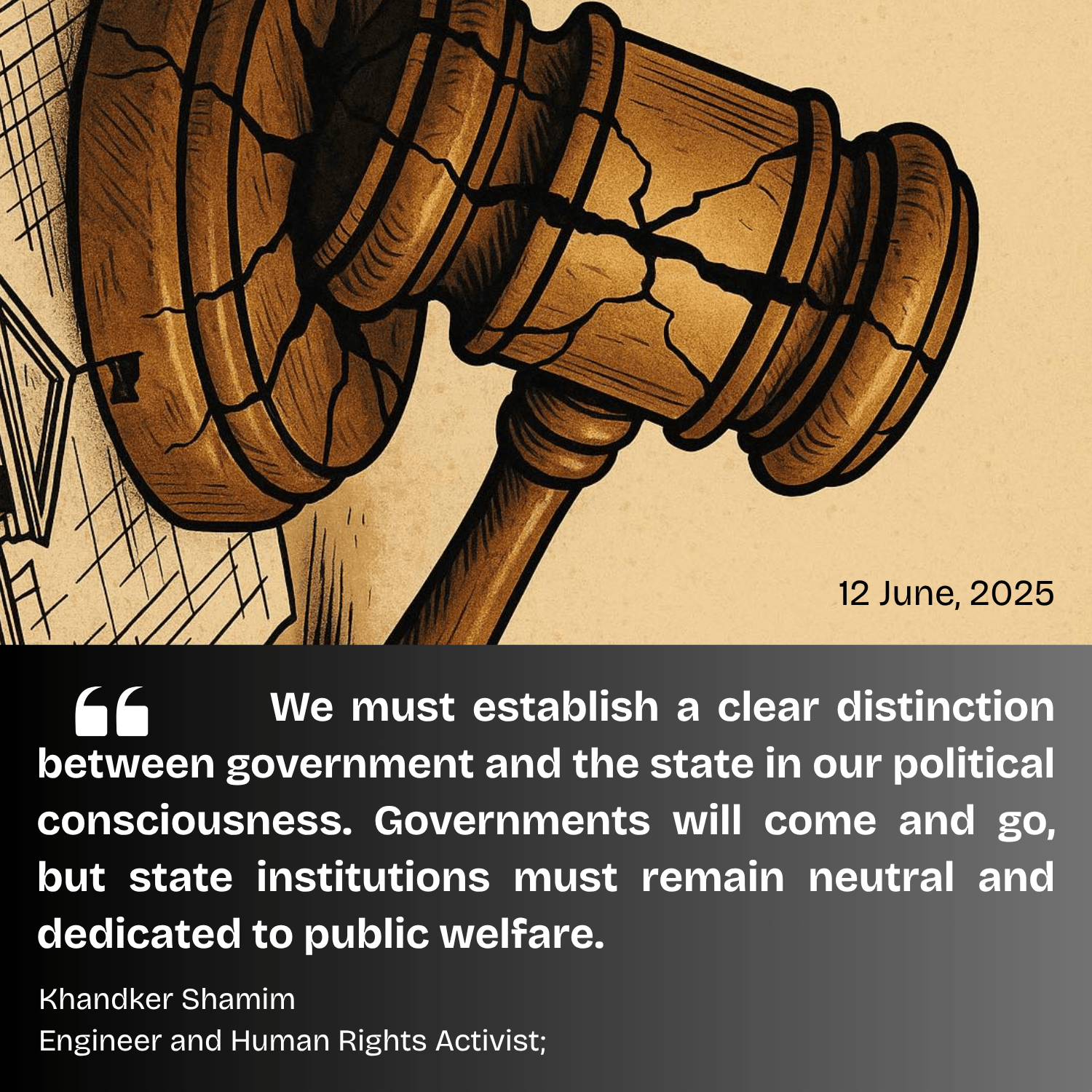
5. Fifth, we must establish a clear distinction between government and the state in our political consciousness. Governments will come and go, but state institutions must remain neutral and dedicated to public welfare.
If these structural reforms are implemented, it won’t matter which party is in power—they will remain bound within the constitutional and legal framework. People, too, will be empowered to ensure good governance through the proper use of their voting rights. At the same time, political parties will feel a greater need for accountability and internal reform.
Recently, BNP acting Chairman, Tarique Rahman stated, "He will not allow any criminals in his party.” This is undeniably a bold and timely statement. Alongside the BNP, other political parties have also clarified their positions against crime and criminals. Now it’s time for responsible individuals in other tiers of the state to say the same—Let not the crime, but the criminal be judged, regardless of their identity.
Now is the time—to fix the state, not deepen political divides. Political differences will always exist—that is a natural reality—but once the state is fixed, politics will be forced to fall in line.
Author Bio:
Khandker Shamim
Engineer and Human Rights Activist
MSS (Peace, Conflict & Human Rights)
Bachelor of Laws (UK), BSc. in Engineering (KUET)

প্লিজ লগইন পোস্টে মন্তব্য করুন!
আপনিও পছন্দ করতে পারেন
- Jun 30, 2025
Bangladesh’s Hidden Wounds: A Nation Failing...
- Jun 23, 2025