- Jun 27, 2026
MIT Research: Bee-Like Robot Lighter Than a Paperclip
- Aug 28, 2025
- Technology
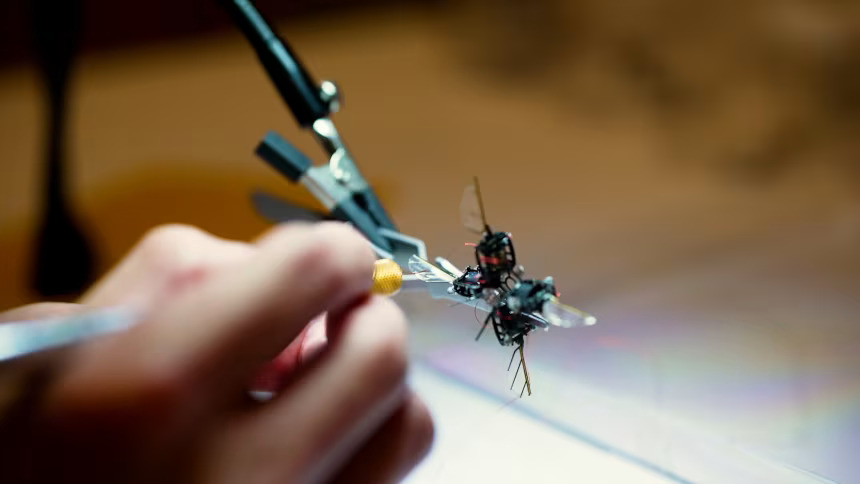
Researchers at the Massachusetts Institute of Technology (MIT) have developed a bee-like robot that weighs even less than a paperclip. This tiny device can flap its wings 400 times per second and fly at speeds of up to two meters per hour. Not only that, it can perform complex maneuvers such as hovering mid-air and flipping unexpectedly.
Researcher E-Hsuan “Nemo” Xiao said, “We are primarily trying to mimic the incredible movement of bumblebees.” According to him, in the future, this technology could be used for artificial pollination—even on other planets.
MIT Associate Professor Kevin Chen explained that the goal is not to replace real bees, but to deploy these robots in environments where bees cannot survive, such as vertical farms with ultraviolet light or warehouse farms for crop production.
Around the world, researchers are developing other robots inspired by the animal kingdom. At Yale University in the United States, scientists have created a cockroach-inspired robot that can detach its limbs if necessary—useful for earthquake or rubble rescue operations. Meanwhile, researchers at Chung-Ang University in South Korea have developed a soft robot capable of crawling and bending like an earthworm.
MIT researcher Suhan Kim has invented artificial muscles that expand and contract to power the bee-like robot’s wing flaps. Tiny components, about the size of a watch mechanism, control its movements.
The team has also developed a grasshopper-inspired robot. Smaller than a human thumb, it can leap 20 centimeters in a single jump and move easily across surfaces like grass, ice, or leaves. Researchers note that jumping robots like this are more energy-efficient than flying robots.
In the future, these tiny robots could be used for complex tasks such as search-and-rescue operations or inspecting pipelines or turbine engines. Currently, they are powered by wires. Researchers say it may take 20–30 more years to incorporate small batteries and sensors for autonomous operation.
Kevin Chen said, “Insects’ movement, behavior, and structure contain millions of years of evolutionary knowledge. We are drawing directions for future technology from that.”
Source: CNN

প্লিজ লগইন পোস্টে মন্তব্য করুন!
আপনিও পছন্দ করতে পারেন


- Jun 27, 2026
OpenAI Faces Debate After Limited Release of...

- Jun 20, 2026
U.S. imposes restrictions on export of advanc...

- Jun 20, 2026
New risk in digital wallets as card provision...

- Jun 18, 2026