- Nov 04, 2026
Lula and Bolsonaro Face Off in Closely Contested Brazilian Presidential Election
- Oct 04, 2026
- International
International Desk | PNN
Brazilian President Luiz Inácio Lula da Silva and right-wing Senator Flavio Bolsonaro have concluded their final campaign activities ahead of the first round of the presidential election. With Sunday’s vote approaching, both candidates have expressed confidence in victory. However, the election is being viewed as highly competitive as the gap between the two candidates has narrowed in recent opinion polls.
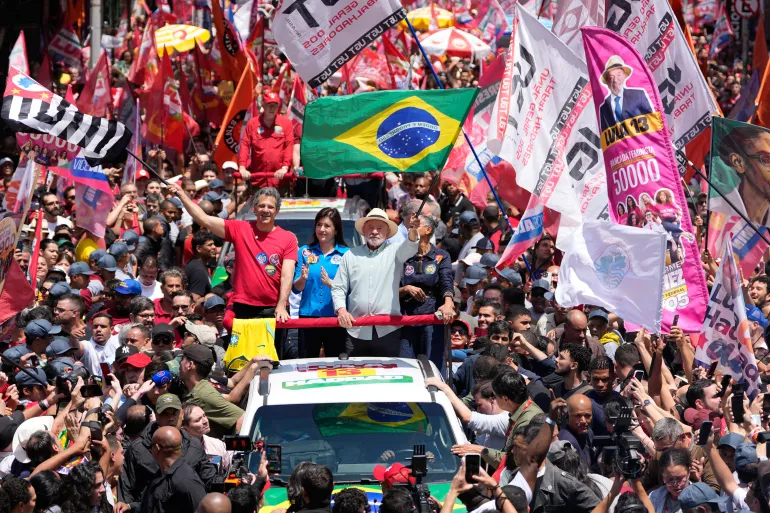
Eighty-year-old Lula ended his campaign on Saturday with a march alongside supporters in São Paulo. His campaign team claimed that a large number of people participated in the final election event.
Addressing supporters, Lula expressed hope that he would win in the first round. He portrayed the election as a struggle between democracy and the far right and called on voters to defeat right-wing forces.
Lula has also brought the role of the United States into the election campaign. Opposing any form of Washington’s interference in Brazil’s domestic politics, he has also presented the election as a test of the country’s sovereignty.
Meanwhile, 45-year-old Flavio Bolsonaro also campaigned extensively until the final moment. He spent time with supporters in different parts of São Paulo state during motorcycle rallies. He later attended a rally in Rio de Janeiro, where he expressed confidence in winning in the first round.
Flavio is the son of former President Jair Bolsonaro. He has placed his father’s political legacy at the center of his campaign. At one rally, he was also seen holding a portrait of his father.
Jair Bolsonaro is currently serving a 27-year prison sentence over allegations that he attempted to overturn the result of the 2022 election, which he lost to Lula. He is known as a close ally of U.S. President Donald Trump.
Although Trump has not formally endorsed Flavio, he has said that he is monitoring Brazil’s election “very closely.” The United States’ interest in the election has sparked renewed controversy during the campaign.
Lula’s supporters accuse Washington of attempting to influence Brazil’s election. Meanwhile, some Bolsonaro supporters angered by the rising cost of living believe that pressure from the United States could bring changes inside the country.
Various opinion polls published on Saturday showed Lula maintaining a lead, but his margin over Flavio Bolsonaro has narrowed compared with previous surveys. As a result, many believe it is unlikely that either candidate will secure the required majority in Sunday’s vote.
In that case, a second-round election will be held on October 25. The two candidates receiving the highest number of votes in the first round will face each other. Opinion polls also indicate that the potential second-round contest could be extremely close.
Compared with the 2022 election, this year’s contest is considerably more competitive. In that election, Lula defeated Jair Bolsonaro by a margin of less than two percentage points.
Toward the end of the election campaign, Flavio Bolsonaro’s campaign team has also come under scrutiny over the financing of a film. An investigation is underway into the financing of a movie titled “Dark Horse,” which is based on the life of his father. There are allegations that a banker imprisoned over a major financial scandal in Brazil was involved in financing the film.
In addition, Brazil’s Supreme Court has authorized the federal police to investigate whether some of Flavio’s statements about Lula were defamatory.
If elected, Flavio has promised to take steps to free his father from prison. At the same time, he has revived his father’s longstanding questions about the reliability of Brazil’s electronic voting system. Some analysts believe such statements are being made as a strategy to prepare the ground for challenging the election results in the event of defeat.
Alongside the presidential election, Brazilian voters will also elect representatives to various national and regional positions on Sunday. Around 160 million registered voters will cast ballots to elect lawmakers, governors and senators.
Right-wing political forces have been gaining popularity in several Latin American countries in recent times. Against that backdrop, Brazil’s election is not merely a question of a change in domestic political power; it could also influence the political direction of the entire region.
The key question now is whether Lula, with his long political experience, can secure victory in the first round, or whether Bolsonaro’s right-wing resurgence will push the election into a second round.

প্লিজ লগইন পোস্টে মন্তব্য করুন!
আপনিও পছন্দ করতে পারেন
- Nov 04, 2026
Republicans Suffer Major Defeat as Democrats...
- Nov 04, 2026
Democrats Win Control of Both Chambers of US...
- Nov 04, 2026
Abdul El-Sayed Set to Become First Muslim US...
- Oct 31, 2026