- Nov 04, 2026
Iran Threatens South Korea With ‘Serious Consequences’ If It Joins US in Strait of Hormuz
- Sep 08, 2026
- International
International Desk, PNN
Iran has warned that South Korea would face “serious consequences” if it becomes militarily involved in the ongoing war involving Iran, the United States and Israel. The warning from Tehran came amid reports that South Korea is considering participating in the United States’ naval blockade operation in the Strait of Hormuz.
Iranian Foreign Ministry spokesperson Esmaeil Baghaei warned South Korea in a statement posted on X on Monday. He said Iran and South Korea have maintained diplomatic relations based on mutual respect for more than six decades and that Tehran attaches importance to the relationship.
However, he warned that the situation would be different if South Korea joins military activities alongside the United States. According to Baghaei, while Iran is fighting to defend itself against US aggression, Tehran would consider any country’s military presence or participation in operations in the Gulf region or the Strait of Hormuz as direct support for the aggressor.
The Iranian official also warned that such a move could have “serious consequences.” At the same time, he urged sovereign states not to yield to pressure from the United States.
Discussions are underway over whether South Korea, a close US ally, will provide any form of assistance to international efforts aimed at keeping navigation normal in the Strait of Hormuz. For South Korea, the issue is important not only diplomatically but also economically.
Around 60 to 70 percent of the country’s crude oil imports come from the Gulf region through the Strait of Hormuz. Disruptions to supplies through this crucial waterway due to the war have already put pressure on South Korea’s economy. Alongside rising energy prices, inflation is also increasing, while the country’s currency, the won, has fallen to its lowest level in 17 years, according to reports.
In this situation, keeping shipping through the Strait of Hormuz operating normally is also directly connected to South Korea’s own economic interests.
South Korean media reports said pressure from the United States is also increasing over Seoul’s possible role in the Iran war.
In mid-August, US President Donald Trump said he had spoken with South Korean President Lee Jae Myung about the Iran war and had urged Seoul to provide some assistance to Washington in the conflict. Seoul, however, did not respond to the request at the time.
After that, Washington reduced the scope of its regular joint military exercises with South Korea. The annual exercise known as “Ulchi Freedom Shield,” which normally lasts for more than 11 days, was limited to five days this time.
In addition, another joint marine exercise scheduled for September has also been cancelled. Washington cited additional pressure on military capabilities caused by the Iran war as the reason.
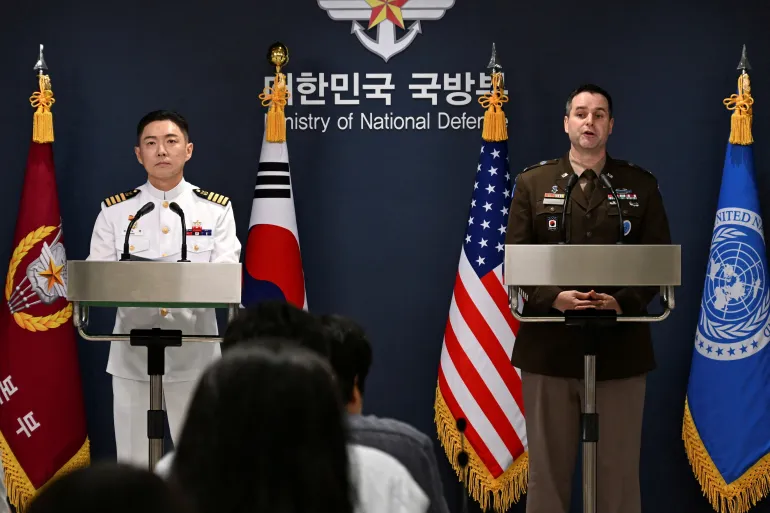
South Korean President Lee Jae Myung is moving forward with discussions with the United States over the issue. However, South Korea’s Yonhap News Agency, citing government sources, reported that Seoul is considering various options for military cooperation as part of international efforts to maintain normal navigation in the Strait of Hormuz.
Potential forms of cooperation include sending forces, in coordination with France, the United Kingdom and other allied countries, for non-combat operations as well as search-and-rescue activities. South Korea’s military is also reviewing the possibility of deploying maritime patrol aircraft, explosive ordnance disposal teams and unmanned systems used to detect and remove sea mines.
However, any such decision could become politically controversial inside the country. The opposition has already opposed the possible deployment of troops. Several members of the ruling Democratic Party are also against it. Protests against the US-Israeli war on Iran have also taken place in various cities across the country.
South Korea and the United States have a long history of close military relations. Their relationship deepened after Washington stood alongside South Korea during the Korean War in 1950. Currently, around 29,000 US troops are permanently stationed in South Korea.
US military assistance is also important to South Korea’s security because of North Korea’s nuclear capabilities. In return, South Korea has cooperated with US military operations at various times.
However, in recent years, pressure has emerged in relations between the two countries over trade and defence issues. In 2025, the United States imposed a 25 percent tariff on South Korean goods, but following negotiations, it was later reduced to 15 percent.
Now, South Korea’s possible military role in the Strait of Hormuz over the Iran war could create new pressure on relations between the two countries. At the same time, because of Tehran’s direct warning, Seoul must take into consideration three factors: its economic interests, its strategic relationship with the United States and the ongoing conflict in the Middle East.

প্লিজ লগইন পোস্টে মন্তব্য করুন!
আপনিও পছন্দ করতে পারেন


- Nov 04, 2026
Republicans Suffer Major Defeat as Democrats...
- Nov 04, 2026
Democrats Win Control of Both Chambers of US...
- Nov 04, 2026
Abdul El-Sayed Set to Become First Muslim US...
- Oct 31, 2026