- Apr 30, 2026
Government moves to cancel duty-free yarn import facility
- Jan 19, 2026
- Business
Staff Report: PNN
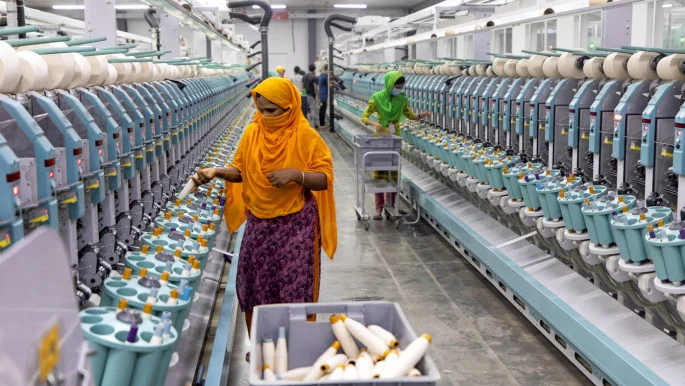
The government has taken major policy initiatives to protect the domestic spinning industry. The long-standing facility allowing duty-free yarn imports under bonded warehouse schemes is being phased out. If implemented, import duties on yarn will increase to approximately 37 percent.
On January 12, the Ministry of Commerce sent a letter to the National Board of Revenue (NBR) requesting indefinite suspension of duty-free yarn imports under bonded facilities. Although no formal notification had been issued by January 18, the proposal has already sparked debate and concern among local textile mill owners and garment industry stakeholders.
Local yarn producers’ associations say the decision will serve as a protective shield for the industry. According to the Bangladesh Textile Mills Association (BTMA), at least 100 spinning mills have partially or completely shut down in recent years due to declining demand for yarn.
Industry stakeholders claim that cheap Indian yarn imports have made it difficult for local mills to compete, as Indian exporters supply yarn at relatively lower prices due to various government incentives.
Multiple mill owners stated that controlling imports will increase demand for domestically produced yarn, allowing closed mills to reopen. On the other hand, leading garment associations like BGMEA and BKMEA have expressed concern that sudden cessation of duty-free imports may raise production costs, negatively affecting exports.
A significant portion of yarn used in knitwear production relies on imports. Currently, Indian yarn is available at $2.55 to $2.60 per kilogram, while domestic yarn costs $2.70 to $2.75. If the proposed restriction is implemented, domestic yarn prices may rise approximately 10 percent to $2.80–$2.85 per kilogram, according to garment industry leaders.
BGMEA leaders noted that global demand for clothing has already decreased. Under these circumstances, increased production costs cannot be passed to buyers, potentially affecting export competitiveness.
According to the Export Promotion Bureau (EPB), Bangladesh imported about $2.22 billion worth of yarn in the 2024–25 fiscal year, mostly from India. The Ministry of Commerce stated that duty-free imports under bonded facilities have risen abnormally over the past two years, directly impacting local production and sales.
Both sides have begun asserting their positions ahead of the government’s final decision. Experts say that balancing domestic industry protection and export competitiveness is the biggest challenge for the government.

প্লিজ লগইন পোস্টে মন্তব্য করুন!
আপনিও পছন্দ করতে পারেন

- Apr 30, 2026
New relaxation in bonus policy to boost motiv...

- Apr 29, 2026
Soybean oil supply shortage increasing, marke...

- Apr 29, 2026
Savings certificates gaining popularity as sa...

- Apr 29, 2026