- Apr 30, 2026
End of six decades of waiting: Government moves forward with Padma Barrage project
- Jan 19, 2026
- Business
Staff Report: PNN
After six decades of discussions, surveys, and planning, the government has finally initiated the implementation of the long-anticipated Padma Barrage project. Recently, the Planning Commission’s Project Evaluation Committee (PEC) reviewed the revised proposal, marking a significant step toward project implementation.
The committee meeting, held last Thursday at the Planning Commission, was chaired by Mostafizur Rahman, member of the Planning Commission for Agriculture, Water Resources, and Rural Institution Affairs. During the meeting, Bangladesh Water Development Board (BWDB) presented the comprehensive aspects of the proposed project.
According to BWDB sources, the project’s initial estimated cost was approximately 50,443 crore Taka. After restructuring the cost and implementation framework, PEC recommended implementing the project in two phases. The first phase is estimated at 34,608 crore Taka, with work scheduled to start in March 2026 and expected to conclude by June 2033.
A senior BWDB official said the revised proposal may be presented for final approval at the Executive Committee of the National Economic Council (ECNEC) meeting on January 25. He noted that while the interim government is willing to commence the project with domestic funding, foreign loans from countries including China may be considered if necessary.
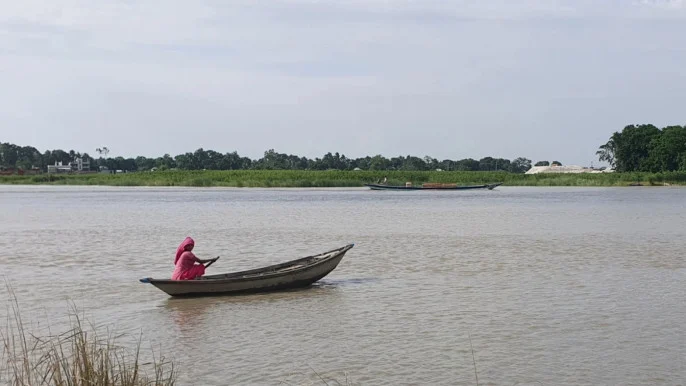
Based on extensive feasibility studies, Pangsapoint in Rajbari district has been identified as the most suitable location for constructing the barrage. Building a 2.1-kilometer-long barrage here will help regulate river flow, store water, and distribute it evenly downstream.
Officials noted that the reduced flow of the Padma River during dry seasons, due to India’s Farakka Barrage, has highlighted the need for such a barrage.
The concept of a Padma or Ganga barrage first emerged in the 1960s. In 1961, the then EPOWADA (now BWDB) conducted the first survey. Over the next four decades, multiple pre-feasibility studies were conducted. In 2002, WARPO recommended barrage construction in Kushtia or Rajbari regions. Between 2009 and 2016, extensive surveys and engineering designs were prepared. During this time, technical discussions continued between Bangladesh and India, including joint site inspections and meetings.
The proposed barrage will include 78 spillway gates and 18 under sluices. A navigation lock for boats and two fish passes will be constructed to ensure natural fish movement. A railway connection will also be established over the barrage.
The project is expected to generate approximately 113 megawatts of hydroelectric power, while supplying water to critical installations including the Rooppur Nuclear Power Plant.
In the first phase, main barrage construction along with the rehabilitation of Hisna-Mathabhanga and Gorai-Madhumati river systems will take place. The second phase will include additional infrastructure and further restoration of river systems.
Reports indicate that the launch of Farakka Barrage has significantly reduced water flow in southwestern Bangladesh during dry seasons, adversely affecting agriculture, fisheries, navigation, and ecosystems. Reduced freshwater flow has also threatened the Sundarbans and its biodiversity.
Officials expect that by conserving water during monsoon, about 2,900 million cubic meters of water can be supplied through various river systems during dry periods. This will reduce salinity, improve irrigation, and protect Sundarbans’ surroundings.
The project is expected to provide irrigation facilities for approximately 1.9 million hectares of land, significantly boosting agriculture in southwestern and northwestern regions of the country.
Professor Mashfiqus Salehin, water resource management expert at Bangladesh University of Engineering and Technology, said the project is the result of long-term planning. Proper design and modern technology can largely control water scarcity and salinity during dry seasons. He cautioned that the river’s natural flow and environmental impacts must be carefully considered during such large-scale construction, and proper management will ensure benefits outweigh potential risks.

প্লিজ লগইন পোস্টে মন্তব্য করুন!
আপনিও পছন্দ করতে পারেন


- Apr 30, 2026
New relaxation in bonus policy to boost motiv...

- Apr 29, 2026
Soybean oil supply shortage increasing, marke...

- Apr 29, 2026
Savings certificates gaining popularity as sa...

- Apr 29, 2026