- Nov 04, 2026
Five Israeli Opposition Leaders Unite to Oust Netanyahu, but Questions Remain Over Palestinian Policy
- Oct 17, 2026
- International
International Desk | PNN
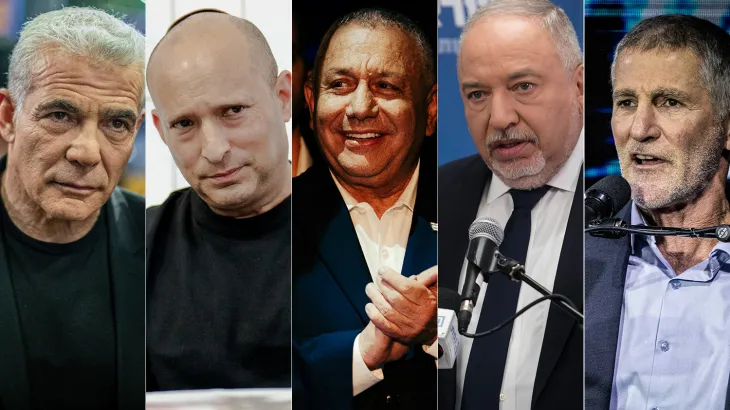
Five Israeli opposition leaders have joined forces ahead of the upcoming election to remove Prime Minister Benjamin Netanyahu from power. At a meeting in Tel Aviv on September 26, they signed a non-aggression pact. Their primary objective is to challenge Netanyahu in the October 27 election and form an alternative government. However, ideological differences and disagreements over the Palestinian issue have raised doubts about how effective the alliance will be.
The meeting was held at the residence of opposition leader Yair Lapid. Participants included former prime minister Naftali Bennett, former military chief Gadi Eisenkot, Democrats Party leader Yair Golan and Avigdor Lieberman, head of the Yisrael Beiteinu party. Alongside the Beyahad alliance led by Lapid and Bennett, the other leaders also agreed to develop a political arrangement aimed at opposing Netanyahu.
In a policy declaration released after the meeting, the leaders said that despite their ideological differences, they shared the goal of forming a Zionist and responsible government to rebuild Israel and bring changes to the way the country is governed.
However, questions remain over how long the unity will last, who would lead a future coalition government and how much policy change would follow if the opposition takes power. Lieberman has already accused Eisenkot of attempting to reach an understanding with Netanyahu. This has created further uncertainty in political circles about the opposition’s unity.
Former military chief Gadi Eisenkot has emerged as Netanyahu’s principal rival within the opposition camp. The 66-year-old politician served as Israel’s chief of staff from 2015 to 2019. He entered politics in 2022 through Benny Gantz’s National Unity alliance. After the Hamas-led attack on Israel in October 2023, he joined the wartime cabinet formed by Netanyahu.
In December 2023, his son Gal and two nephews were killed while participating in the war in Gaza. In June 2024, Eisenkot left the wartime cabinet alongside Gantz, accusing Netanyahu of lacking a clear strategy for ending the war.
The following year, he formed the centrist Yashar Party. His political agenda includes establishing a professional government, making military service compulsory for everyone, including ultra-Orthodox Jews, and setting up a state commission to investigate security failures before the October 7, 2023, attack.
However, his positions on the Palestinian issue and regional conflicts remain unclear in several respects. Although he has not questioned the objectives of Israel’s military operations, he has criticised excessive dependence on the United States. Eisenkot has also ruled out the possibility of forming a government with the Arab party United Arab List, known as Ra’am, after the election.
Former prime ministers Naftali Bennett and Yair Lapid announced the formation of a joint electoral alliance called Beyahad, meaning “Together,” in April this year. The two leaders served as prime minister in succession between 2021 and 2022.
Bennett, 54, has long supported the expansion of Israeli settlements in the occupied West Bank. He leads the alliance. Lapid, 62, is the founder of the centrist Yesh Atid party. Although Lapid has criticised how Israel’s military operations are viewed internationally, he has generally not questioned the fundamental justification for those operations. Bennett is known for taking a harder-line position and strongly supports Israel’s military operations against Iran.
Both leaders now favour forming a government made up exclusively of Zionist parties. Their plan also rules out relying on the support of Arab parties.
Avigdor Lieberman, founder of the Yisrael Beiteinu party, is known among the opposition leaders for taking one of the hardest-line positions on security issues. He established the party in 1999 to represent right-wing, Russian-speaking immigrants.
Although he was once a close ally of Netanyahu, Lieberman is now unwilling to join a government led by him. He also opposes a government that includes ultra-Orthodox parties or depends on support from Arab parties. This position could become an obstacle to establishing Eisenkot as the opposition coalition’s candidate for prime minister.
Some Israeli political analysts believe Lieberman remains part of the alliance primarily because of his personal opposition to Netanyahu. However, his own support base and political influence make him difficult to ignore. Observers have not ruled out the possibility that he could return to Netanyahu’s right-wing camp if circumstances change.
Among the five leaders, Yair Golan is considered relatively left-wing. He leads the Democrats Party, which was formed in 2024 through the merger of the Labour Party and the centre-left Meretz party. A retired major general, Golan is more willing than the other leaders to work with Palestinian political groups.
He has also criticised the government’s objectives and strategy in the war in Gaza. However, his position on Palestinians’ aspirations for independence and the limits of cooperation with Arab political parties remains controversial. Golan also faced criticism last September for supporting a decision to disqualify Sami Abu Shehadeh, leader of the Arab Balad Party, from the election.
According to Ahron Bregman, an Israel analyst at King’s College London, the influential figures in the opposition alliance largely represent right-wing politics. He said there were no indications of major changes in their positions on fundamental issues such as Palestinian aspirations for independence and the broader Palestinian question. Their differences with Netanyahu primarily concern leadership style, corruption allegations and dependence on the far right.
Although the opposition leaders agree on removing Netanyahu, they have no consensus on establishing a Palestinian state. Golan’s party acknowledges this objective as a distant possibility, but the other leaders have not made a clear commitment to Palestinian statehood. Their positions are also limited when it comes to recognising the war in Gaza as genocide or raising fundamental objections to Israeli military actions in Lebanon, Syria, Yemen, Qatar and Iran.
According to analysts, the alliance’s main challenge is not simply to increase its number of seats in the election. It must also manage internal disagreements, form a government and maintain power afterwards. Roy Zurer, an expert on Israeli politics at the University of Essex, believes it could be difficult to form a winning coalition without the support of both Lieberman and Golan. Despite their differences over security and conflict, the two leaders share common ground on issues such as secularism and opposition to granting exemptions from military service to ultra-Orthodox Jews.
The October 27 election will therefore determine not only Netanyahu’s political future but also the political arrangement under which Israel’s next government may be formed. However, even if opposition unity brings a change of government, it remains uncertain whether Israel’s policies on Palestinian independence and regional conflicts will undergo any significant change.

প্লিজ লগইন পোস্টে মন্তব্য করুন!
আপনিও পছন্দ করতে পারেন
- Nov 04, 2026
Republicans Suffer Major Defeat as Democrats...
- Nov 04, 2026
Democrats Win Control of Both Chambers of US...
- Nov 04, 2026
Abdul El-Sayed Set to Become First Muslim US...
- Oct 31, 2026