- Nov 04, 2026
Fighting intensifies again in Yemen, 46,000 people displaced
- Sep 12, 2026
- International
International Desk | PNN
After several years of relative calm in Yemen, devastating conflict has erupted again. At least 46,000 people have fled their homes in just one week amid renewed intense fighting between Houthi rebels and forces loyal to the internationally recognized government, according to the United Nations.
Several conflict-affected areas, including Taiz, have suffered the most. On Friday, reports emerged that the Houthis had captured Mokha and taken control of the last remaining stretch of the Red Sea coast that had been outside their control. Panic subsequently spread through government-controlled areas, triggering another wave of mass displacement.
More than five years ago, Aman Murshed, a woman in her fifties, had begun living as a displaced person in a camp in the Al-Qadaha area of Taiz. She had been dreaming of returning home to her family farm and livestock. But the renewed conflict has shattered that hope.
After the fighting began, Aman was forced to leave the camp with her children at dawn. With no nearby vehicle available, she walked more than two kilometers before eventually reaching the Al-Malika camp in Al-Ma’fer district in a pickup truck.
Although relatives are staying at the new camp, adequate shelter has not yet been arranged for her family. The shortage of food is also severe. They are surviving largely on food provided by neighbours.
Aman’s biggest concern is the livestock she left behind. During the previous displacement, she had somehow managed to take the animals with her, but this time that was impossible. She fears they have died amid the intense fighting.
More than the lack of food and essential supplies for herself, Aman is worried about the future of her children. Children in the camp are being deprived of regular education, adequate nutrition and other necessary services.
The United Nations Office for the Coordination of Humanitarian Affairs (OCHA) said at least 46,000 people have been displaced in Yemen since the renewed conflict began last week. A large proportion of them are trying to find shelter in the Al-Ma’fer area of Taiz.
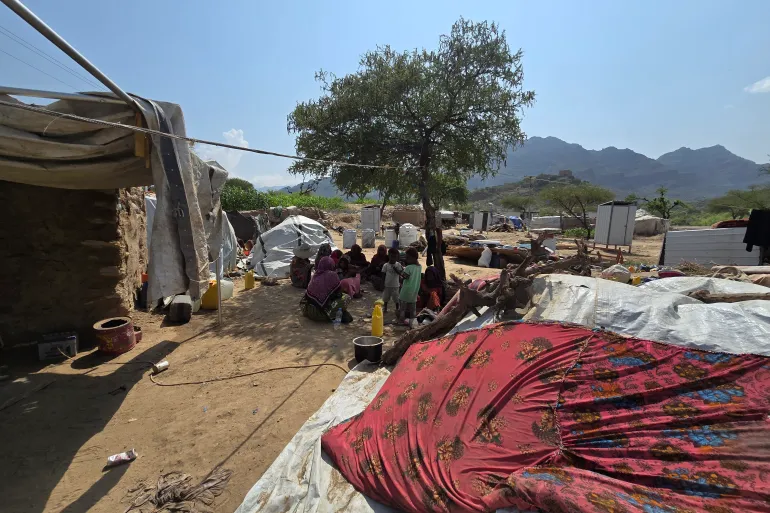
However, the camps there have limited capacity. As a result, hundreds of families are crowded into narrow tents or are spending nights wherever they can beside the tents. Some people who cannot find space are spending the daytime under trees.
Ali Qaed, director-general of the Executive Unit for the Management of Displaced Camps in Taiz, said most displaced people had moved to the Al-Ma’fer area because of the deteriorating security situation. However, the existing camps are not equipped to accommodate such a large influx of new arrivals.
He said coordination with humanitarian organizations was underway to respond to the emergency. However, the current humanitarian response remains extremely limited compared with the scale of the needs.
The experience of Ahmed Abduljalil, a man in his forties who took shelter at the Al-Ghazalia camp in Al-Ma’fer, is similar to Aman’s. After the conflict spread again, he fled with his family at dawn on Friday, leaving their previous place of refuge in Jabal Habashi district.
He complained that the presence of humanitarian organizations in the camp remains inadequate. Women and children are spending nights under plastic sheets, while many men are being forced to stay in the open. A severe food shortage has compounded the situation.
Abdulnaser Al-Sururi, manager of the Al-Ma’fer branch of the local NGO Peace and Social Security Organization, said humanitarian operations had already become difficult because of a lack of funding even before the new wave of displaced people arrived.
According to him, displaced families need basic services including food, shelter, clean water and sanitation supplies. But due to limited funding, it is not possible to provide assistance to everyone. He said rapid intervention by international organizations and the United Nations was necessary to address the situation.
Many people among those displaced by the renewed conflict have also been injured. Munir, a man in his forties, was shot in the left leg while fleeing the Jabal Habashi area. He was injured when he suddenly came under gunfire while escaping with other families amid the fighting.
Although he has been discharged from the hospital, he still has to walk with the help of a stick. Frustrated by the long-term effects of the war, Munir has only one wish: that the fighting stops and people are able to return to normal life.
Conflict between the Houthis and pro-government forces has continued in Yemen since the Houthis seized the capital, Sanaa, in September 2014. After a ceasefire agreement brokered by the United Nations in April 2022, major fighting largely subsided. However, sporadic clashes and regional tensions continued during that period.
The renewed fighting that began this month is being viewed as the most intense conflict in several years. At the same time, tensions surrounding the Red Sea have also taken on a new dimension.
During the Gaza war, the Houthis attacked several ships traveling along Yemen’s coast, prompting the United States and United Kingdom to carry out airstrikes on various Houthi positions. During the war surrounding Iran in July 2026, the Houthis also threatened to attack Saudi-linked vessels in the Red Sea. Subsequently, several attacks were reported against ships and Saudi Arabian energy facilities in the region.
According to Taiz journalist Mohammed Ali, after several years of relative calm, many Yemenis had hoped the war would end and normal life would return. Discussions were also underway among various parties. However, the recent regional conflict has dealt a major blow to those hopes.
Meanwhile, intense fighting has also occurred in recent days in the provinces of Al-Jawf, Marib and Al-Bayda. New displacement is also taking place in these areas.
According to UN data, Yemen has a population of around 35 million, and approximately 22.3 million people will require humanitarian assistance and protection in 2026. The number of internally displaced people is estimated at around 5.2 million.
As a result, the renewed spread of conflict is expected to deepen Yemen’s long-standing humanitarian crisis. While the warring parties continue to fight on the battlefield, ordinary people who have lost their homes, particularly women and children, are paying the highest price.

প্লিজ লগইন পোস্টে মন্তব্য করুন!
আপনিও পছন্দ করতে পারেন


- Nov 04, 2026
Republicans Suffer Major Defeat as Democrats...

- Nov 04, 2026
Democrats Win Control of Both Chambers of US...

- Nov 04, 2026
Abdul El-Sayed Set to Become First Muslim US...

- Oct 31, 2026