- Jun 27, 2026
After Three Failures, SpaceX’s Starship Test Flight Finally Succeeds
- Aug 27, 2025
- Technology
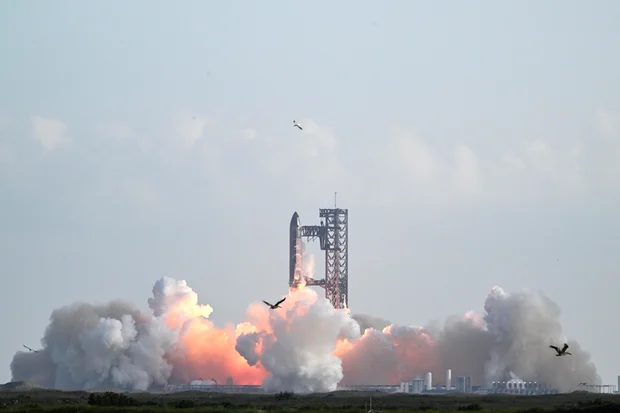
Although delayed by two days, SpaceX’s massive Super Heavy–Starship rocket successfully launched into space from the Starbase facility in Texas on Tuesday, August 26. Following three consecutive failed test flights, this launch is being regarded as a major success, bringing relief to the company and its founder, Elon Musk.
During the reentry of Starship’s upper stage, one of the control flaps partially melted due to intense heat, and the protective casing around the engine section was damaged. Nevertheless, the rocket remained under control and safely splashed down in the Indian Ocean as planned. SpaceX posted on X (formerly Twitter), “Splashdown confirmed! Congratulations to the entire team for the successful tenth test flight.”
Earlier, the first stage, the Super Heavy booster, propelled the rocket into space with the roar of 33 Raptor engines before itself floating down and landing in the Gulf of Mexico. Even with one engine intentionally shut down, the booster completed the test as planned.
The experimental mission lasted over an hour, and the excitement and joy of the SpaceX team were evident. After three consecutive failures, this success has reignited hope for the company’s future projects.
During Tuesday’s launch, the 40-story-tall rocket generated nearly 16 million pounds of thrust, double the power of NASA’s SLS rocket developed for the Artemis program. As part of the test, eight artificial satellite modules were successfully deployed into orbit from Starship, and the engines were reignited in space. Although the rocket’s body showed signs of extreme heat damage during reentry into Earth’s atmosphere, control was maintained.
SpaceX aims to use Starship not only for satellite launches but also for manned lunar landings and eventually to establish a colony on Mars. However, significant technical challenges remain, including fuel refueling, long-term survival in orbit, and safe landing.
NASA plans to use a version of Starship to send two astronauts to the Moon in 2027, but experts caution that overcoming all these obstacles in such a short time will be difficult.
Nevertheless, Tuesday’s launch demonstrated that despite technological limitations, SpaceX is steadily progressing toward its ambitious goals.

প্লিজ লগইন পোস্টে মন্তব্য করুন!
আপনিও পছন্দ করতে পারেন


- Jun 27, 2026
OpenAI Faces Debate After Limited Release of...

- Jun 20, 2026
U.S. imposes restrictions on export of advanc...

- Jun 20, 2026
New risk in digital wallets as card provision...

- Jun 18, 2026