- Oct 31, 2026
Protests Over Education Reform in France Put Macron Government Under Scrutiny
- Oct 20, 2026
- International
International Desk | PNN
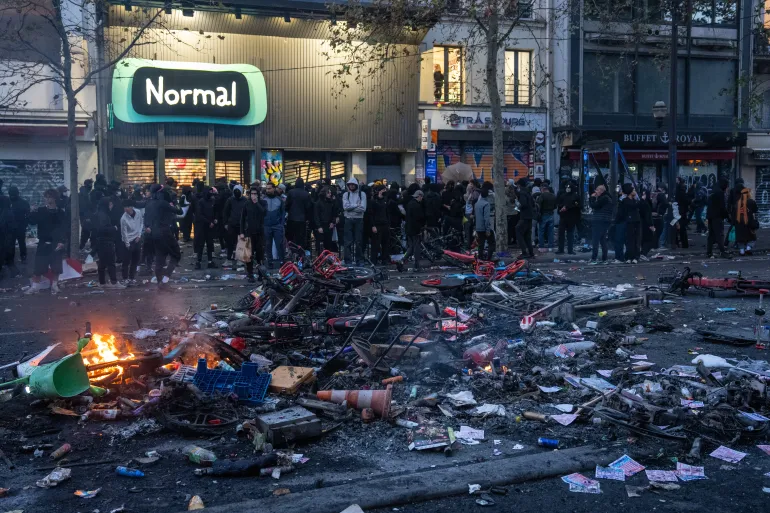
Violent protests by students demanding reforms to France’s education system have reignited political tensions across the country. President Emmanuel Macron has said that students’ grievances and demands must be taken seriously, while also warning that those involved in vandalism and looting under the cover of protests will face strict action. However, a large section of the protesters remains dissatisfied with the government’s response. They allege that despite the assurances, no concrete plan for reforming the education system has been presented.
In a speech delivered on Sunday night, Macron said those who had destroyed public and private property would have to pay compensation. Those involved in looting would also be required to make good the losses suffered by the victims. He added that anyone who had attempted to undermine the foundations of the republic would be held accountable.
However, the president’s remarks failed to reassure Yanis, a 20-year-old from Ivry-sur-Seine, a southeastern suburb of Paris. In his view, Macron’s speech did not clearly reflect any new initiatives. He said it was a familiar type of presidential statement that offered no practical proposals for implementation. He also said protesters would continue taking to the streets every weekend until meaningful changes were introduced.
The violent protests that spread across France last weekend have brought growing dissatisfaction among young people with the country’s political leadership into the spotlight. Analysts believe young people are becoming increasingly disillusioned with Macron’s centrist politics. With the 2027 presidential election only months away, the unrest has further exposed divisions among political parties.
As France approaches its next presidential election, political parties are attempting to capitalise on the public dissatisfaction generated by the protests. Left-wing leader Jean-Luc Mélenchon has openly expressed support for the student movement. Far-right leader Marine Le Pen, meanwhile, has focused on the violence, looting and breakdown of law and order during the demonstrations. Prime Minister Sébastien Lecornu has accused the far left of using the violence as a form of rehearsal ahead of the presidential election.
After serving two terms, Macron will not be eligible to run in the next presidential election. As various political camps compete to position themselves to succeed him, the support of young voters has become increasingly important. Although there is broad agreement that young people want change, there is no political consensus on what form that change should take.
Political analyst Béligh Nabli, a professor of public law at the University of Paris-Est Créteil (UPEC), said candidates would have to make their positions on young people’s demands clear. Statements directed at young voters could not remain merely formal gestures; they needed to offer realistic responses to their expectations.
The student movement began in mid-September, initially calling for better schools, adequate teacher recruitment and equal access to education. It subsequently spread beyond educational institutions and onto the streets, incorporating broader social and economic grievances.
According to analysts, young people’s relatively low participation in elections has traditionally encouraged political parties to prioritise the interests of older voters and issues such as pensions. The ongoing protests, however, have brought questions about young people’s education and future to the centre of political debate.
In Nabli’s words, without this movement, young people’s demands might once again have been overlooked during the election campaign, as younger voters generally participate less actively in elections than those over 60.
The left-wing party France Unbowed, led by Mélenchon, has strongly backed the student movement. Critics of the party accuse it of attempting to exploit young people’s anger for political gain. However, the party already enjoyed support among young voters before the protests began.
Its political programme includes demands for increased investment in education, better salaries for teachers and changes to the university admissions application system. In particular, some young people support calls to abolish Parcoursup, the online platform used for higher education applications. They argue that the system raises questions about the transparency of the admissions process.
A poll conducted by OpinionWay for the newspaper Les Échos, published last Thursday, found that 49 percent of voters aged 18 to 24 supported Mélenchon. This represented an increase of 10 percentage points compared with 2022.
Lydia, a 21-year-old student at the Louvre School in Paris, said she wanted to vote for France Unbowed as an alternative to the far-right National Rally and Macron’s centrist politics. She fears that if centrists remain in power, Macron’s policies will simply be repeated.
However, Lydia is also not convinced that the left-wing party can solve all of France’s problems. In her view, even left-leaning opinions are increasingly being labelled extremist. She said that showing compassion for others now seems to be regarded as an extreme left-wing position.
Marine Le Pen and her National Rally party, meanwhile, are portraying the violence during the protests as evidence of a crisis of law and order and state authority. They accuse the government of failing to control the situation and Mélenchon’s party of inciting violence.
In a video message released on Sunday night, Le Pen said the country’s cities, roads and public assets had been subjected to vandalism and looting. In her words, France was facing a deep crisis of confidence and authority that could become a threat to democracy. She also said the country was trapped between violence and a government that appeared helpless.
Le Pen continues to lead among potential presidential candidates in election polls, with support at 32 percent. The National Rally ranks second among voters aged 18 to 24, behind France Unbowed.
Social discontent has been a major challenge for Macron’s government since the beginning of his political career. Early in his presidency, the Yellow Vest movement emerged in protest against increases in fuel taxes. It later developed into broader demonstrations centred on the rising cost of living and allegations that the government favoured wealthy and elite groups.
Under the current circumstances, the next government could find it even more difficult to manage the crisis. The scope for using public spending to ease protests is more limited than it was previously. Last year, France’s budget deficit reached 5.1 percent of gross domestic product (GDP), one of the highest levels in Europe. During the same period, the European Union’s average deficit stood at 3.1 percent.
As a result, the next president will have to control public spending while also preventing spending cuts from intensifying public anger.
Meanwhile, Macron’s approval rating has fallen to 15 percent, reportedly a record low for him. In his Sunday speech, he blamed rebellious members of far-left groups and criminals for the violence but did not announce any detailed new policy measures addressing the students’ demands.
Instead, he assigned Prime Minister Lecornu the task of holding discussions with students, teachers, labour organisations and elected representatives and preparing proposals within the next few days. Macron also promised strict action against those responsible for the violence.
France’s current situation is no longer confined to the question of education reform. It has developed into a broader debate about young people’s trust in political leadership, economic inequality and the role of the state. Winning the support of young voters could become a major challenge for the country’s competing political camps ahead of the 2027 presidential election.

প্লিজ লগইন পোস্টে মন্তব্য করুন!
আপনিও পছন্দ করতে পারেন

- Oct 31, 2026
Senior Commander Siddig Ander Announces Depar...
- Oct 31, 2026
Fears of Halloween-Weekend Protests Prompt He...
- Oct 25, 2026
Hundreds of Thousands Protest Again in France...
- Oct 25, 2026