- May 08, 2026
Dangerous Air Pollution Warning in Delhi During Diwali Fireworks
- Oct 21, 2025
- International
International Desk | PNN:
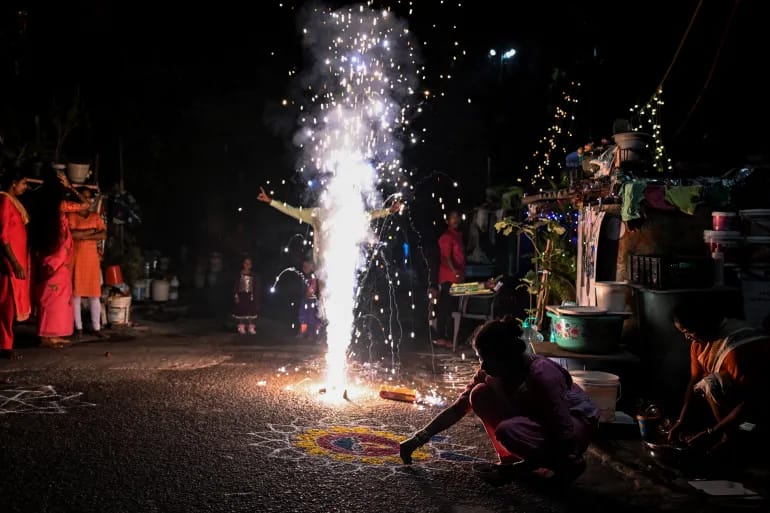
The air pollution in India’s capital, New Delhi, has once again reached some of the worst levels in the world. Fireworks during the Hindu festival of Diwali caused pollution levels across the city to exceed record levels, according to Swiss air quality monitoring company IQAir.
On Tuesday morning (October 21), Delhi’s Air Quality Index (AQI) reached 442, which the organization described as the worst in the world.
Every year during October–November, a combination of fireworks smoke, vehicle emissions, industrial discharge, and agricultural burning leads to dangerously high levels of toxic particles in Delhi’s air.
IQAir reported that on Tuesday morning, the PM2.5 particle concentration in the city was 59 times higher than the World Health Organization’s (WHO) annual safe limit.
The Central Pollution Control Board (CPCB) of India stated that Delhi’s air quality is currently at a “very poor” level, with an AQI of 350. For reference, an AQI from 0 to 50 is considered good.
Last week, India’s Supreme Court partially relaxed the ban on fireworks, allowing “green crackers” or low-emission fireworks for a maximum of three hours on Sunday and Monday.
However, in reality, fireworks were set off for hours in many parts of the capital, rapidly deteriorating air quality.
The Ministry of Earth Sciences of India has warned that Delhi’s air quality will remain “very poor to poor” over the coming days, with the AQI fluctuating between 201 and 400.
During the winter season, cold air traps smoke, dust from construction, and burning agricultural waste over the city like a thick fog. Nearly 20 million residents suffer from respiratory and lung-related problems during this period.
In previous years, measures such as school closures, halting construction work, and restrictions on private vehicles were implemented to tackle the situation.
Last November, Delhi was engulfed in severe smog, with the AQI surpassing 1,700 in a single night—over 17 times the acceptable limit.
According to IQAir, Lahore, Pakistan, had an AQI of 234 on Tuesday, the second-highest in the world.
The Punjab provincial government in Pakistan has already taken emergency measures to reduce pollution, including controlling agricultural burning, managing smoke-emitting vehicles, and deploying anti-smog guns in polluted areas.
“Currently, air coming from Punjab and other parts of India is spreading pollution into our skies, severely affecting air quality in various regions of Pakistan,” officials said.
While the Diwali festival begins with joy and celebration, this year, as in previous years, it has also made breathing difficult for millions across South Asia.

প্লিজ লগইন পোস্টে মন্তব্য করুন!
আপনিও পছন্দ করতে পারেন

- May 08, 2026
UK local elections: Labour under pressure as...
- May 08, 2026
Fuel price hike in Yemen increases pressure o...

- May 07, 2026
Investigation launched into Israeli soldier o...

- May 07, 2026