- Jul 06, 2026
Country’s Economy ‘Bleeding’ Due to Non-Performing Loans and Energy Crisis
- Nov 28, 2025
- Business
Staff Report: PNN
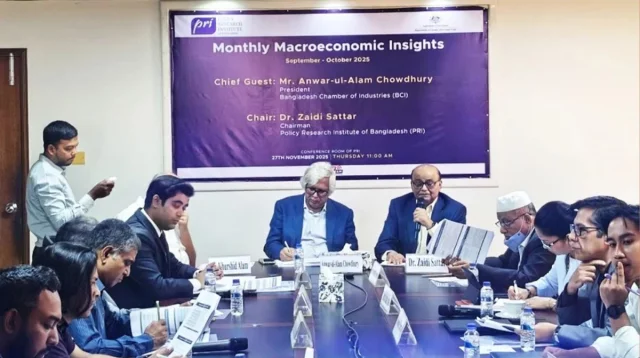
Businesspeople and economists have commented that the country’s economic activity is slowing down, and non-performing loans in the banking sector have reached a dangerous level. Anwar Ul Alam Chowdhury Parvez, President of the Bangladesh Chamber of Industries (BCI), said at the monthly economic review meeting organized by the Policy Research Institute (PRI) on Thursday, “The country’s economy is bleeding. The government is not showing interest in businesspeople’s concerns. Bank credit flow has reduced, affecting production and investment.”
He added that businesses currently taking bank loans are mostly using them to repay old debts to avoid default. “Currently, non-performing loans exceed 35%, which is well above the IMF’s medium-risk threshold. Reducing the rescheduling period will increase defaults further,” he said.
He also expressed dissatisfaction with the government’s energy policy. Since 2022, energy shortages have disrupted production, and about 50% of small and medium enterprises have closed. The capital’s population has exceeded nearly 30 million, creating pressure on essential goods and transport systems.
PRI Chairman Dr. Zaidi Sattar said, “The Real Effective Exchange Rate (REER) has increased, which is worrying for exporters. The government should adopt a flexible import policy to support exports.” He added that despite slower economic activity, stability has been achieved, but liberal policies are needed to boost employment and investment.
Chief Economist Dr. Ashiqur Rahman warned that failing to control non-performing loans would pose risks to the country’s medium-term economy. “Outstanding loans of about BDT 6.4 lakh crore are putting pressure on the banking and productive sectors, creating a ‘toxic cycle’ of high interest rates, low investment, and weak growth.”
Panelists also expressed concern over tax policies, political influence, and the lack of quality education. Dr. Nasiruddin Ahmed said, “Politicians and businesspeople should be involved in tax policy formulation to ensure effective implementation.” Dr. Wasel Bin Sadat added, “85% of the economy is still informal, limiting the effectiveness of tax policies.”
Experts warned that unless the non-performing loan crisis is addressed, Bangladesh could get trapped in a cycle of high interest rates, inflation, and low growth—a challenge beyond the banking sector, affecting the overall economy.
প্লিজ লগইন পোস্টে মন্তব্য করুন!
আপনিও পছন্দ করতে পারেন


- Jul 06, 2026
Gold Price Reduced by Tk 3,266 Per Bhori, BAJ...
- Jul 06, 2026
Government Invites Investment to Revive 44 St...
- Jul 06, 2026
Government Reconstitutes Public Procurement C...
- Jul 03, 2026